Inside the IYP Collection: A Conversation with Irene Panagopoulos
At a time when the art world chases spectacle, some pursue a more discreet—and far more meaningful—collecting mission. ARTCOLLECTORNEWS spoke with Irene Y. Panagopoulos, the vision behind the IYP Collection, as she opens her new public space.
Fernweh, or Nostalgia for Unknown Lands, the inaugural exhibition of the collection, stands among the year’s most significant cultural debuts—a glimpse of what the future of collecting could be. At its center is Irene Y. Panagopoulos herself: a collector whose sincerity, clarity, and loyalty to artists distinguish her in a landscape often dazzled by the temporary. She does not follow trends; she gently shapes a lasting vision.
And while some openings unveil exhibitions, this one introduces a creative ecosystem—a space that redefines what collecting means today. Speaking with her, it becomes clear the vision was never guided by market choreography but by instinct, curiosity, and a lifelong desire to understand both the world and the self.
After forty years navigating the global seas of shipping, Panagopoulos now moves through the intimate waters of art. Her compass is simple: sincerity, simplicity, and the quiet courage of being oneself. The new space sits just two floors below her office, symbolizing the two worlds she inhabits—of responsibility and revelation.
What began with a few works gifted by her father has grown into a collection spanning centuries and regions: Greece, the Balkans, the Middle East, Italy, North Africa—a two-decade exploration of identity, geography, womanhood, and human relations. Fernweh, or Nostalgia for Unknown Lands offers a rare look into this living organism—and affirms her belief that everyone stands equal before art. Her space invites closeness rather than reverence; visitors can sit with the works, examine them, be part of them, and find inspiration. A quietly radical gesture in a world rethinking the white cube.
Her philosophy is refreshingly humane: art belongs to people, and it grows when shared. Fernweh, or Nostalgia for Unknown Lands, thoughtfully curated by the collection’s manager, Katerina Hadji, the first public presentation of the Irene Y. Panagopoulos Collection in Athens, represents a cultural shift. It offers connection, tenderness, and the thrill of discovery—an opening that will resonate far beyond Athens and redefine what a contemporary collection can offer the world.
ARTCOLLECTORNEWS: Before we dive into the collection, can you tell me when you first realized that art—and art collecting—would become an integral part of your life?
IRENE Y. PANAGOPOULOS: It takes many years to reach that point where you become truly preoccupied with art. Now we have the space—in my office building, actually. I work in the shipping company on the fifth floor, and on the second floor I have the art space. How much does it preoccupy me? Quite a lot. A big chunk of my time. I’ve been involved in shipping for 40 years, and I’m slowly moving toward what makes me happiest, which is my collection and the art space. And now that the collection is open to the public, the communication with people is something I didn’t know to be so rewarding. So I’m gradually shifting toward being fully absorbed by art. Still, I’m involved in my work every day. I would say I make a living from shipping, but my life is fulfilled by art.
Lito Kattou (b.1990) | Warrior III, 2017 | Steel, car paint, aluminium, minerals,chains, plastic | 188 x 157 x 76 cm | Irene Y. Panagopoulos Collection | Photo by: Nikos Alexopoulos
ARTCOLLECTORNEWS: That’s very inspirational. There’s a major shift happening right now where collectors and collections are moving closer to the artists themselves, creating more direct connections. The traditional white-cube gallery space is becoming a bit more obsolete. So in many ways, you’re far ahead with what you’re doing. We’re seeing people around the world starting to incorporate art into their daily environments and their work, but you’re already there.
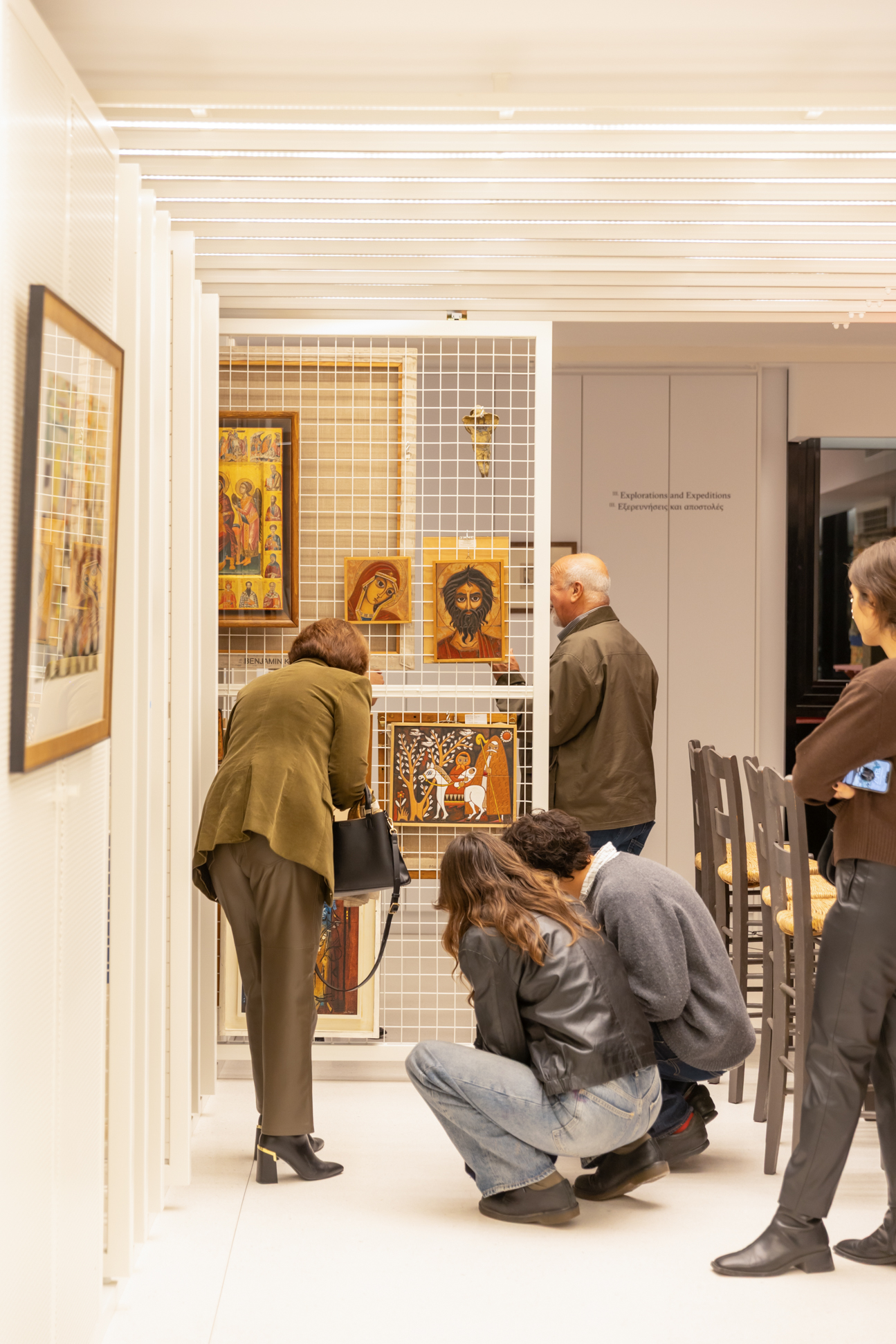
I.Y.P: Yes, yes—our space is much more than that. I believe the art world functions as an ecosystem, and everyone in it is equally important. We need museums, collectors, galleries, art spaces, residencies—each plays a vital role. What we try to offer is a much closer, more intimate approach to art. There’s a table where you can sit with the works; you can even touch certain pieces, if you like. You can observe them up close. We encourage a far more personal, human connection with the art.
ARTCOLLECTORNEWS: What an initiative! This brings collectors closer to artists and supports young creators directly, without intermediaries. Do you think this model helps create a more honest art ecosystem?
I.Y.P: Yeah, and we are addressing, on the same level, academics and just people who like to see art. We've had refugees visit our collection, which is amazing. We are very pleased with how people are accepting this opportunity to have another space to witness and explore art.
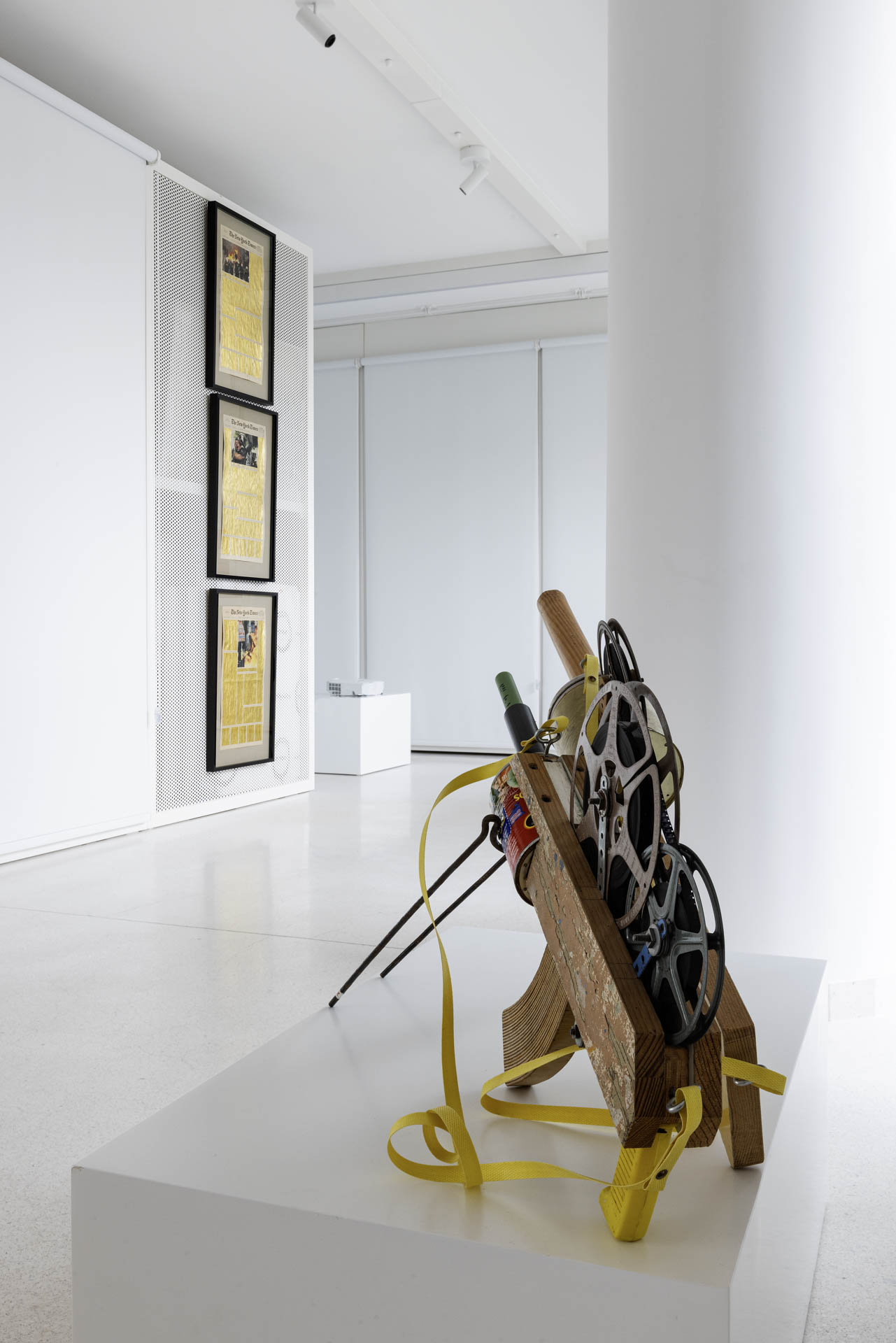
From left to right: Panos Tsagaris (b. 1979) | The Union, 2011 | Gold leaf on newspaper, triptych | 56 x 30 cm each | Francis Alÿs (b. 1959) | Camgun #67, 2008 | Wood, metal, plastic, film reel, film | 48 x 62.5 x 42 cm & Francis Alÿs (b. 1959) | Camgun #76, 2008 | Wood, metal, plastic, film reel, film | 36 x 74 x 36 cm | Irene Y. Panagopoulos Collection | Photo: Nikos Alexopoulos
ARTCOLLECTORNEWS: Going back to how it all began—you’re a cultural advocate, an investor in shipping, an art patron, and you also come from a family with a collecting tradition. How do you perceive your own place in this history? As a significant force in the art world, how do you see yourself within this whirlwind of art and influence?
I.Y.P: I don’t have a partner in my collecting—it’s been a very personal journey. When I was a child, if you had asked me what I wanted to be when I grew up, I never would have said ‘collector.’ I might have said ‘artist,’ because I studied art and at one point wanted to become an artist. But life took me on a different path—I had to work to make a living, and I became dedicated to the family business.
At some point, my father gave me a few paintings from his collection, and that was really the beginning of my own collection. I started with those four or five works and asked myself, ‘How can I build around these?’ Initially, I just wanted to expand a little on what he had collected. I began by exploring Greek artists, since my father had mainly collected artists from Greece from the 60s, 70s, and some 80s. Over time, I also started looking at Greek artists of the diaspora.
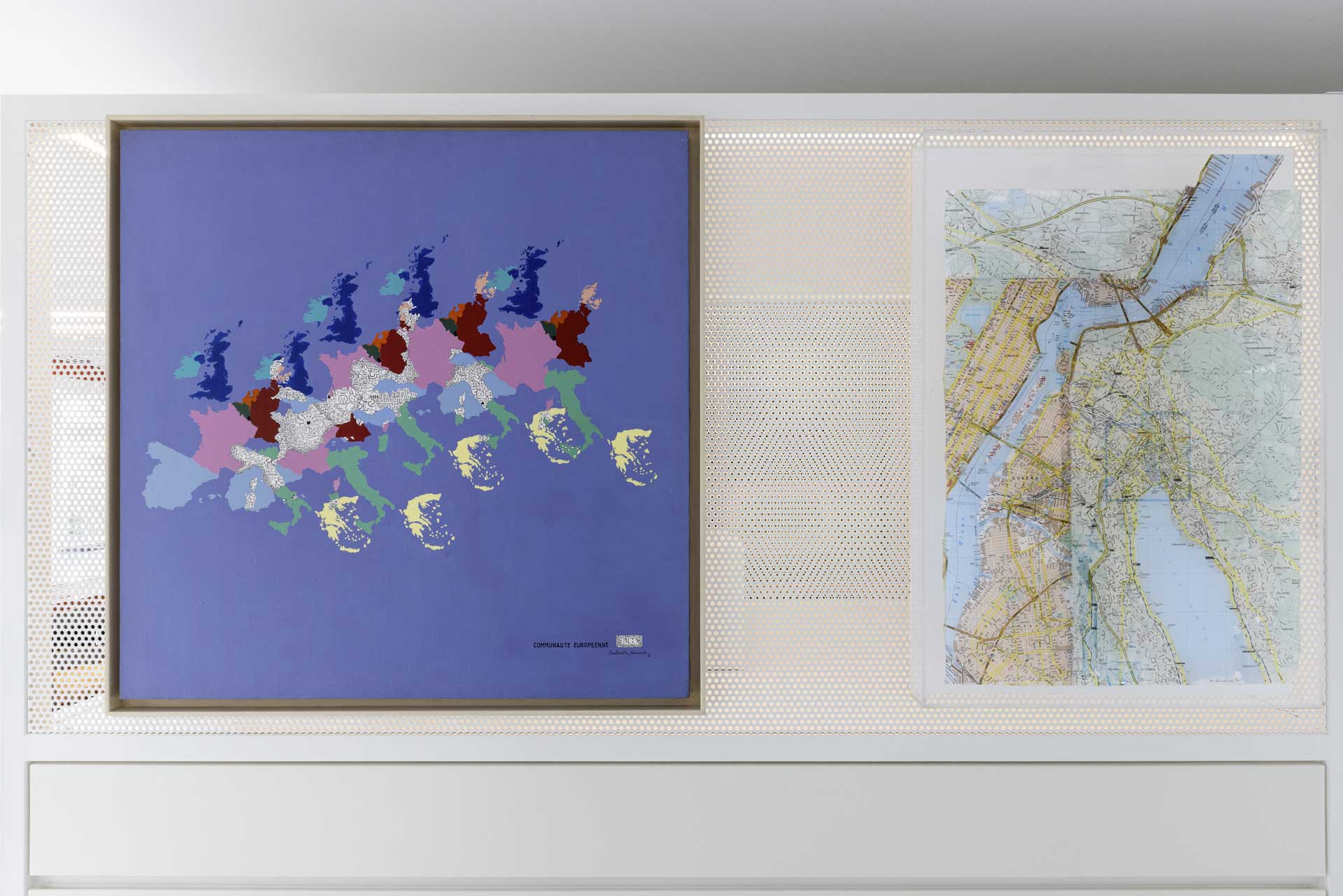
Costantin Xenakis (1931–2020) | Communauté européenne, 1982 | Acrylic on canvas | 100 x 100 cm | Chryssa Romanos (1931–2004) | Map–Labyrinth, 1997 | Decollage on plexiglas | 100 x 70 x 6 cm | Irene Y. Panagopoulos Collection | Photo by: Nikos Alexopoulos
As I began attending art fairs outside Greece, I became aware of amazing international artists, and the collection naturally started to grow. Over the past 20 years, I’ve been building it systematically. The collection has evolved into different sections, with themes and groups that developed over time rather than being planned from the start.
For example, I’m interested in how the world perceives women, so I have a part of the collection focused on that. I’m also interested in other themes, like our relationship with our neighbors here in Greece. Geographically, the collection centers on the southeastern Mediterranean, stretching to the Middle East, Turkey, and the Balkan states. Over the last 20 years, the art scene in the Balkans has changed dramatically—Albania, Romania, and other countries have become vibrant art places to note. I also explore Italy and North Africa. The collection continues to grow, reflecting those themes, in the midst of East and West, a region that resonates with me.
The collection is a live organism. I'm still collecting. And I'm not sure which way I'm moving now. Not too far from what I have been doing, but for sure new concerns come to my mind.
ARTCOLLECTORNEWS: Can you share which were the first pieces you collected yourself? Do you remember a core memory or a meaningful encounter—perhaps with an artist or a book—that shaped that experience? What were your earliest vivid memories of collecting?
I.Y.P: Well, my first collection was of artist’s books. These are works of art, but in the form of a book. I’ve always loved them, and I still collect artist’s books today. When I started, many artists didn’t give much value to these works, but I was fascinated by how a book artwork changes with every turn of the page. It was also something I could afford at the time.
I have books by many important artists. Some of the ones that really shaped my taste include Tracey Emin, Yto Barrada, and John Baldessari, to name a few. Those early books played a significant role in guiding the artists I would collect later.
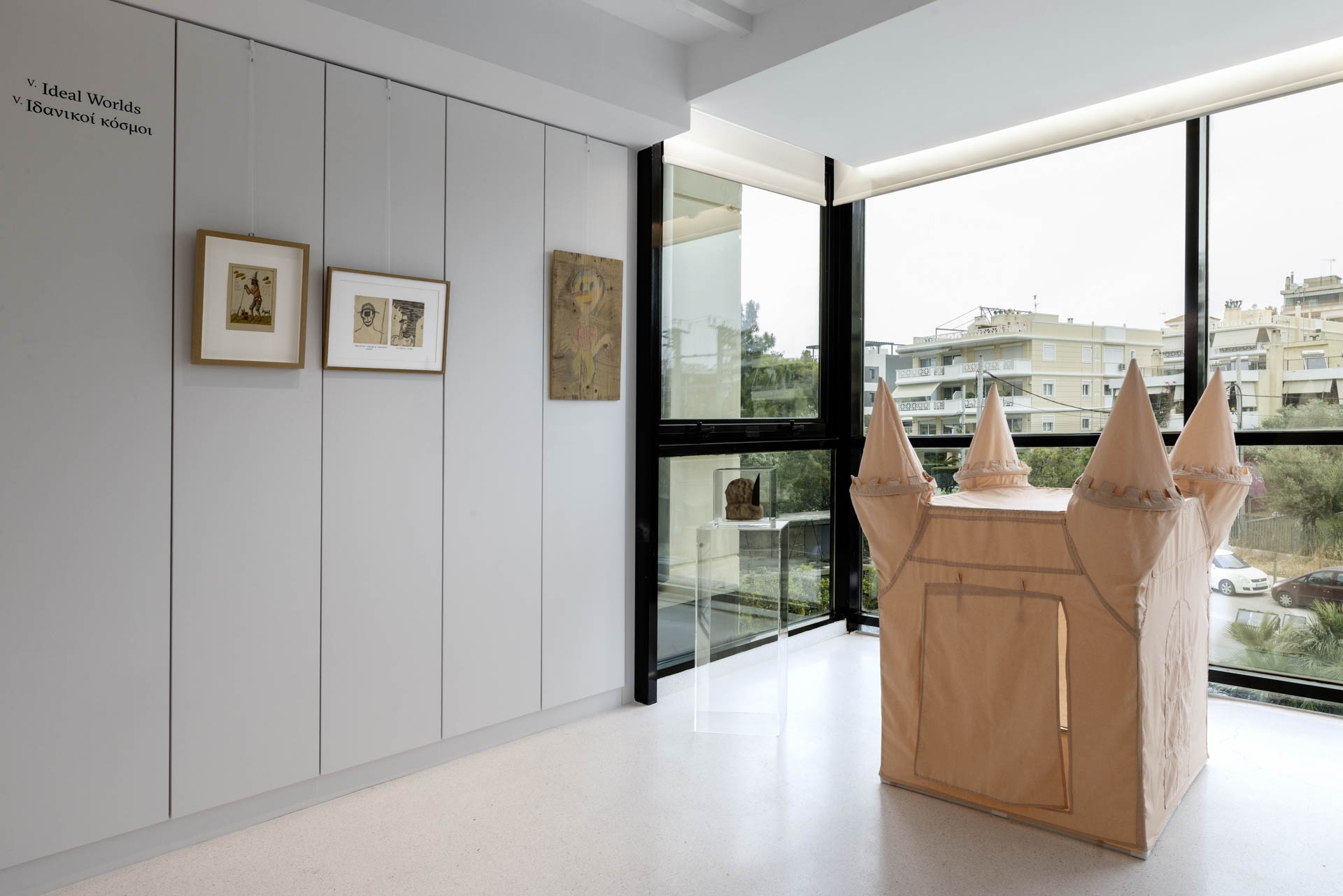
From left to right: Rallis Kopsidis (1929–2010) | Robinson Crusoe on His Island, 1958 | Tempera on carton paper | 18.2 x 12.7 cm | David Sampethai (b. 1989) | Don Quixote Staring at Imaginary Enemies / The Knight’s Return, 2017 | Ink on paper | 46 x 31 cm | Sidsel Meineche Hansen (b. 1981) | Gallery Pinocchio, 2020 | Crayon on wood | 56 x 33 cm | Ron Nagle (b. 1939) | Paper Bysmal, 2012 | Ceramic, catalyzed polyurethane, epoxy resin | 18.5 x 16 x 7.5 cm | Alix Vernet (b. 1991) | Inspection Notice, 2019 | Textile, plastic supports | 130 x 80 x 80 cm | Irene Y. Panagopoulos Collection | Photo by: Nikos Alexopoulos
ARTCOLLECTORNEWS: It’s very interesting that you mention books, because they’re such personal objects that one can truly make their own.
I.Y.P: Yes, yes. This is before I started collecting, before Google or AI, when you had to really do footwork to do research and discover artists and works of art. So, the books came first, and it’s where the collection basically started.
ARTCOLLECTORNEWS: And from that first encounter with artist’s books, how did the collection evolve into what it has become today? What are the key milestones, like different artworks that you saw and said, this is a stepping stone—something that appealed to you deeply and signaled a change in the collection, a new era, a personal journey?
I.Y.P: Yeah, I'm sure that there were milestones. I think going to Art Basel for the first time, and seeing the level of the works exhibited, the immense selection that makes you need to focus. Then I understood how important it is to be able to stay focused on your vision and the things that really preoccupy you. So I follow my instinct and curious mind.
ARTCOLLECTORNEWS: That’s the most important.
I.Y.P: Yeah, yeah, yeah. But it's a vast world. The world of art is vast. So, you need to be able to have a collecting focus and a clear idea of what you want the collection to be. I pause and review this question occasionally because as I grow with my peer artists, I understand that different ideas and different issues may come into the collection, subjects that move me. I'm still collecting. And I'm not sure which way I'm moving now, but certainly not too far from social issues. New concerns come to my mind. We see a lot of conflict. I have to say that it really bothers me. Why can't we avoid conflict? I’m looking at art for answers.
ARTCOLLECTORNEWS: Such an important statement. It’s just you and the artwork, without trends, and how you choose to support art. I think this perspective is crucial, not just in the art world, but in life—art is one of the foundations. Moving to your collection and the new space, opening it to the public is remarkable. As trends fade and crises come, galleries, dealers, and intermediaries risk becoming obsolete. You are creating an open world that truly reflects who you are and what you do.
I.Y.P: We are showing the works in the collection—it’s not about me, it’s about the art. Yet, a collection inevitably reflects the collector as well. A big part of my collection is about ethos, dialogue, and what makes us human. It’s not about me personally, but about concerns and ideas that have mattered to me over the years.
What fascinates me is seeing how different people—curators, art professionals, or those less familiar with art—interpret the collection in so many ways. It’s been a wonderful discovery to see how people connect with the works differently from how I do. Everyone’s reactions have been positive, and it’s amazing to witness how art can evoke emotions, revive forgotten feelings, or create new connections. For me, it’s a truly rewarding dialogue with people through art.
ARTCOLLECTORNEWS: What was your most challenging acquisition so far? Logistically, emotionally, conceptually—something that taught you something?
I.Y.P: Some artworks are very complex—logistically, managing a collection is extremely elaborate. It requires constant care. We face significant conservation challenges, especially with 20th-century works, which demand specialized knowledge of ingredients and chemistry. When I acquire a work, I don’t usually think about logistics, but size is a major factor, especially for storage.
For display, we rotate artworks depending on the curation, which requires careful planning and organization. We have a dedicated team to help with the space, handling, and maintenance of the collection. The archive is also extensive—papers might sound easy to store, but they require careful handling and proper conservation facilities. Honestly, the logistics alone could fill an entire article.
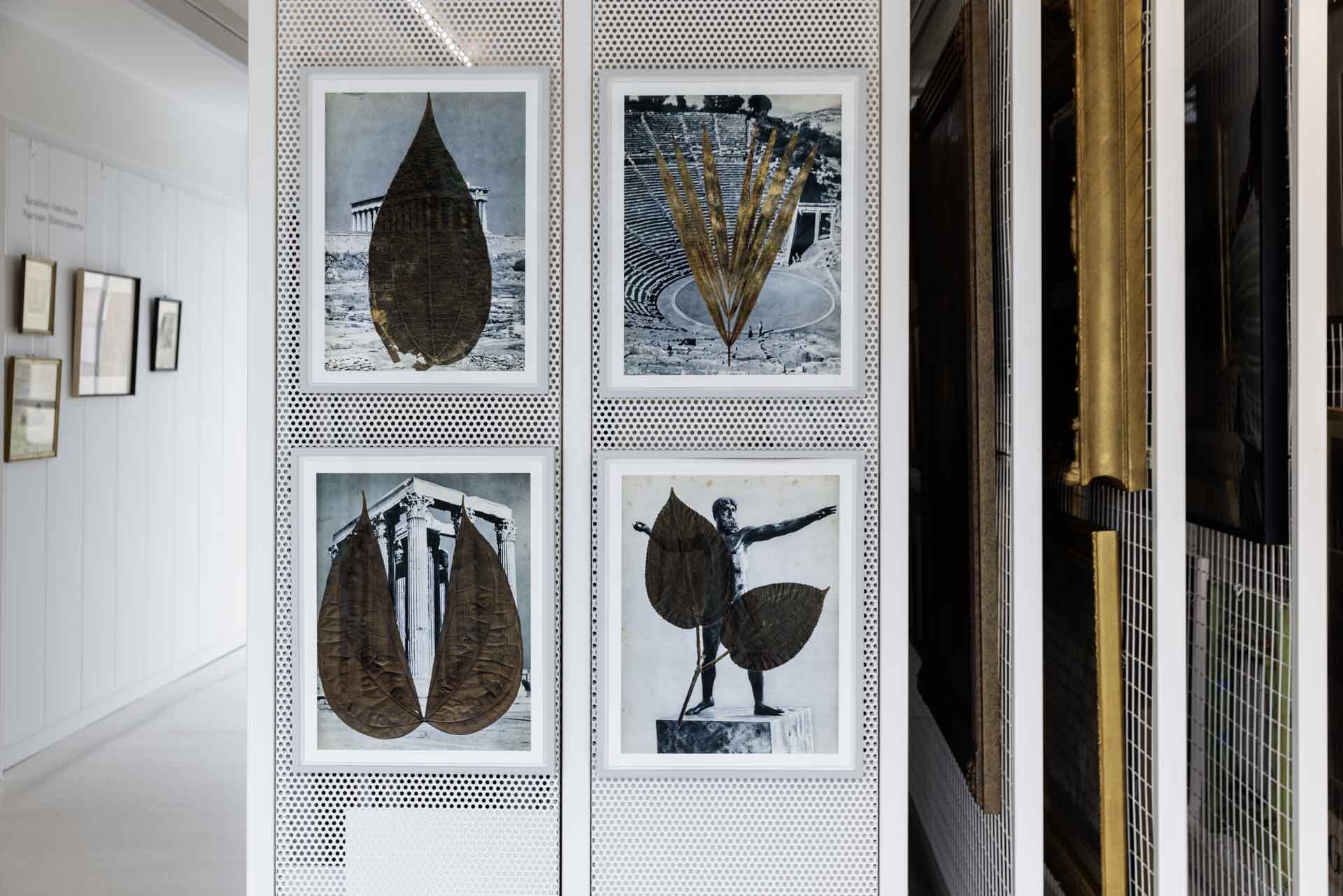
Christoph Keller (b. 1967) | Archaeology Plant Series (1–4), 2014: 1) Hephaestion, 2) Epidaurus Theater, 3) Olympeion, 4) Poseidon of Artemision | Pigment print on photo rag | 54 x 43 cm | Irene Y. Panagopoulos Collection | Photo by: Nikos Alexopoulos
ARTCOLLECTORNEWS: That's true. It's a whole different endeavor, isn't it?
I.Y.P: The logistics of handling a collection, my God. You know, it's like when you want to be a mother, but you have no idea what it means. I definitely see it as a good connection to this whole idea of managing. So, you start acquiring works of art and then you never knew it was so much.
Babies need care, love. They change, they grow, and they need new clothes all the time. But like being a mother, you don't say, oh my God, what did I get into? You love being a mother. Yeah. So, I love collecting.
ARTCOLLECTORNEWS: Such an insightful comparison—a very important point that really encapsulates everything we’ve discussed. If a young collector asked you how to build a meaningful collection—and, as you said, focusing not on trends but on their personal connection with the artwork—what would be your three essential rules? What advice would you give to someone just starting out in collecting?
I.Y.P: Well, starting a collection is like looking in the mirror. You don't know right away what you're looking at—okay, you're looking at yourself, but I think collecting is a process of discovery. And I say: use your instinct. However, in the beginning, you do need some advice. You need to talk with people around you, or find a mentor, a friend who is a collector, who is closer to the art world than you. Ask questions, go to museums, explore art, see what inspires you. And collecting doesn't need a big budget. You can start very small. But collecting is a passion.
ARTCOLLECTORNEWS: That’s such a refreshing point about the budget—how it’s really about loving the work. Collecting is often associated with big budgets and large-scale pieces, but you’ve presented it in such a personal, true, and essential way.
I.Y.P: Yes. So, eventually—like you asked about the milestones of collecting. One milestone for me was when I scaled up my budget, and that was a new phase. But that’s not how you start. Collecting is a long discovery process.
I do hear about immediate collections—people who buy at once blue-chip works because they have the means—which is fantastic. That’s a collection too, but it’s a different type of collection.
For someone young who wants to put something meaningful in their life, I would say: approach it thoughtfully. Just as we select furniture or choose a house carefully, choose art wisely. What moves you? What inspires you? What would you like to see on your wall—painting, sculpture, photograph, video? That’s my advice: make it meaningful.
ARTCOLLECTORNEWS: Looking ahead, can you share any tips or updates about the future of the collection? Where do you see it going, both in terms of exhibitions and personally, and how do you envision the new space?
I.Y.P: We have many ideas to explore with our collection in our space. We’ve started a public program that includes talks, presentations, and performances based on the current curation and themes. We’re expanding the ways the collection can be experienced by the public.
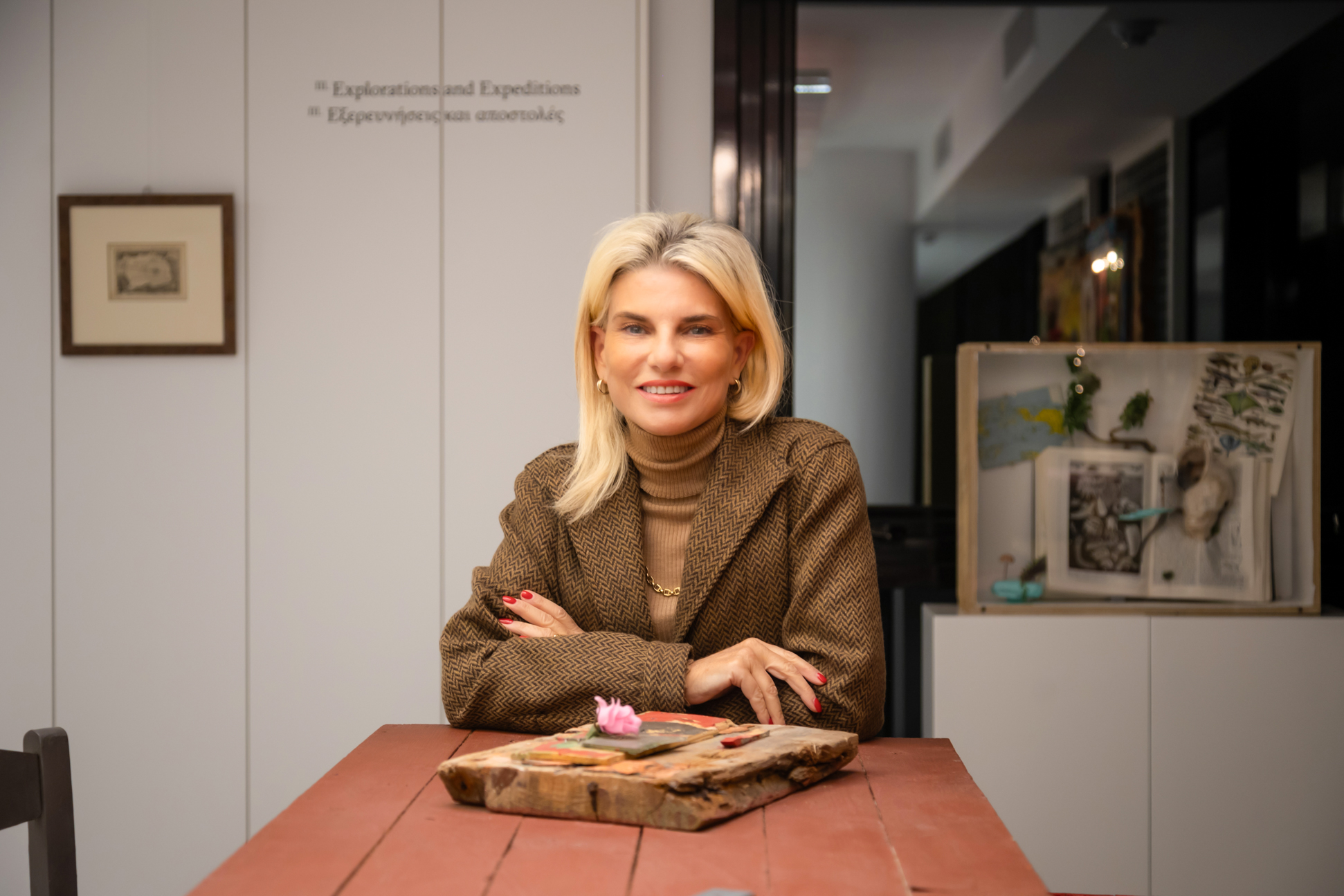
Irene Y. Panagopoulos Collection, Irene Y. Panagopoulos Collection Space. Photo by: Pinelopi Gerasimou
Entry is free, and we’re also expanding the archive and library to make them more accessible. There’s already a lot of interest in this material. We want the space to nurture both the study and the experience of art in a more personal way, and we aim for it to be accessible to as many people as possible.
ARTCOLLECTORNEWS: I know we are tight on time, so I would like to thank you for speaking with us and sharing your inspirational words and collecting story.
Fernweh, or Nostalgia for Unknown Lands
Curated by: Katerina Hadji
Featuring Alexis Akrithakis, Francis Alÿs, Andreas Angelidakis, Yüksel Arslan, Richard Artschwager, Kader Attia, Minas Avramidis, Maja Bajević, Petrus Bertius, Selina Bracebridge, Vlassis Caniaris, Louis-François Cassas, Étienne Chambaud, Salvador Dalí, Paul Alfred de Curzon, Alphonse de Neuville, Silvina Der-Meguerditchian, Stelios Faitakis, Ormond Gigli, Pegeen Vail Guggenheim, José Gutiérrez de la Vega, Nikolaos Gyzis, Ernst Haas, Nikos Hadjikyriakos-Ghika, Thomas Hartley Cromek, William Heather, Lito Kattou, Christoph Keller, Bouchra Khalili, Rallis Kopsidis, Maria Loizidou, Kostas Malamos, Alain Manesson Mallet, Takis Marthas, Sidsel Meineche Hansen, Ron Nagle, Adrian Paci, Giorgos Paralis, Callirhoe Parren, Angelo Plessas, Georgios Prokopiou, Polykleitos Rengos, Chryssa Romanos, David Sampethai, Charles Sandison, Wilhelm Sasnal, François-Louis Schmied, Sister Corita, Edward Steichen, Thomas Struth, Rosemarie Trockel, Panos Tsagaris, Yiannis Tsarouchis, Spyros Vassiliou, Eleni Vernadaki, Alix Vernet, Vincentius Demetrius Volicius, Johann Jakob Wolfensberger, Francesca Woodman, Constantin Xenakis, Raed Yassin and anonymous artists.
Irene Y. Panagopoulos Collection 157, Konstantinou Karamanli Avenue, Voula, 166 73 (entrance via 146, Vasileos Pavlou Avenue)
Exhibition Duration June 12, 2025 – February 27, 2026
At a time when the art world chases spectacle, some pursue a more discreet—and far more meaningful—collecting mission. ARTCOLLECTORNEWS spoke with Irene Y. Panagopoulos, the vision behind the IYP Collection, as she opens her new public space.
Máret Ánne Sara’s Goavve-Geabbil transforms Tate Modern into a living landscape of hides, bone, sound, and spirit. Rooted in Sámi cosmology, the installation marks a powerful return of shamanic presence in contemporary art—an immersive call to reconnect with land, ancestors, and the unseen.
Miami Beach is about to trade in its sunscreen for art, ambition, and audacity, as Art Basel 2025 takes over the city in a whirlwind of color, ideas, and unapologetic creativity. From Havana to São Paulo, New York to Kyiv, 283 galleries are landing in the Sunshine State, bringing a global parade of Modern masters, postwar icons, and daring emerging voices. This year, the fair is shining a spotlight on Latinx, Indigenous, and diasporic artists—because if Miami is the crossroads of the Americas, Art Basel is the crossroads of ideas. Get ready for a week where the beach vibes meet bold statements, and the cocktail of culture is curated with intellectual rigor.


-min.jpeg)