
October 25, 2026
Exhibitions
Exhibitions

A rare London exhibition of new works and historical material returns us to Cady Noland’s uncomfortable vision of American spectacle, power and the ordinary object.
A gallerist’s Clinton Hill apartment reveals how painting, sculptural furniture, family history and unorthodox choices can make a home feel genuinely collected.
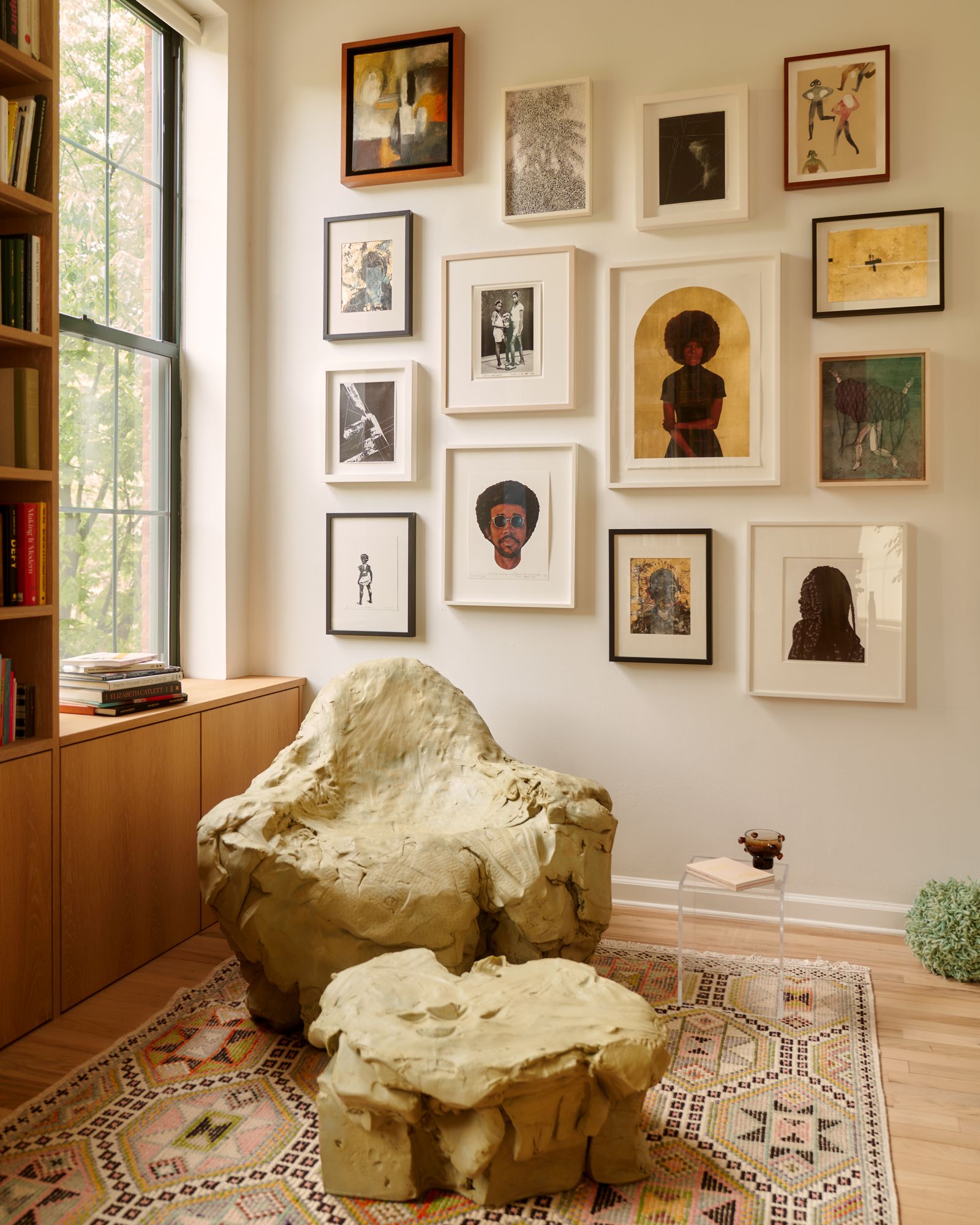
An art collector’s home reveals its philosophy long before anyone reads the labels. In the Clinton Hill apartment of Joeonna Bellorado-Samuels, senior director at Jack Shainman Gallery, one unusually telling decision is the absence of a conventional sofa. The space favours sculptural chairs, strong works of art and furniture with a recognisable point of view. Comfort here is not a neutral set of upholstered objects around a coffee table; it is something negotiated with the personalities of the things that share the room.
Architectural Digest photographed and reported on the home in October 2026, with an article by Sean Santiago and photography by Seth Caplan. This ARTCOLLECTORHOMES feature is an independent editorial interpretation of that published reporting, not a separate interview or a claim that we visited the apartment. Its central subject is a question that concerns many serious collectors: how can a domestic space hold demanding art without becoming either a showroom or a storage facility?
Bellorado-Samuels has lived with artworks by artists including Barkley L. Hendricks, Kerry James Marshall and Sadie Barnette. The works create an encounter with different artistic generations and visual languages, rather than the impression of a collection purchased in a single aesthetic mood. An interior can look coherent without imposing uniformity on its art. Indeed, the most interesting rooms often make space for disagreement.
This approach differs from the familiar image of the minimalist collector’s house, where works are given pristine walls and few contextual distractions. Here the home’s history, its objects and the rhythms of daily life form part of the frame. The visitor encounters art alongside books, seating and things valued for personal reasons. Such proximity can make the collection less ceremonious and more deeply understood.
The apartment includes striking design objects and a distinctive sculptural chair by Urs Fischer. Custom elements created with millworker Paul Finsterwald bring a different kind of authorship into the rooms: pieces designed to answer specific spatial and practical needs. That combination of collectible forms and made-for-place furniture helps prevent the interior from becoming a catalogue of recognisable design names.
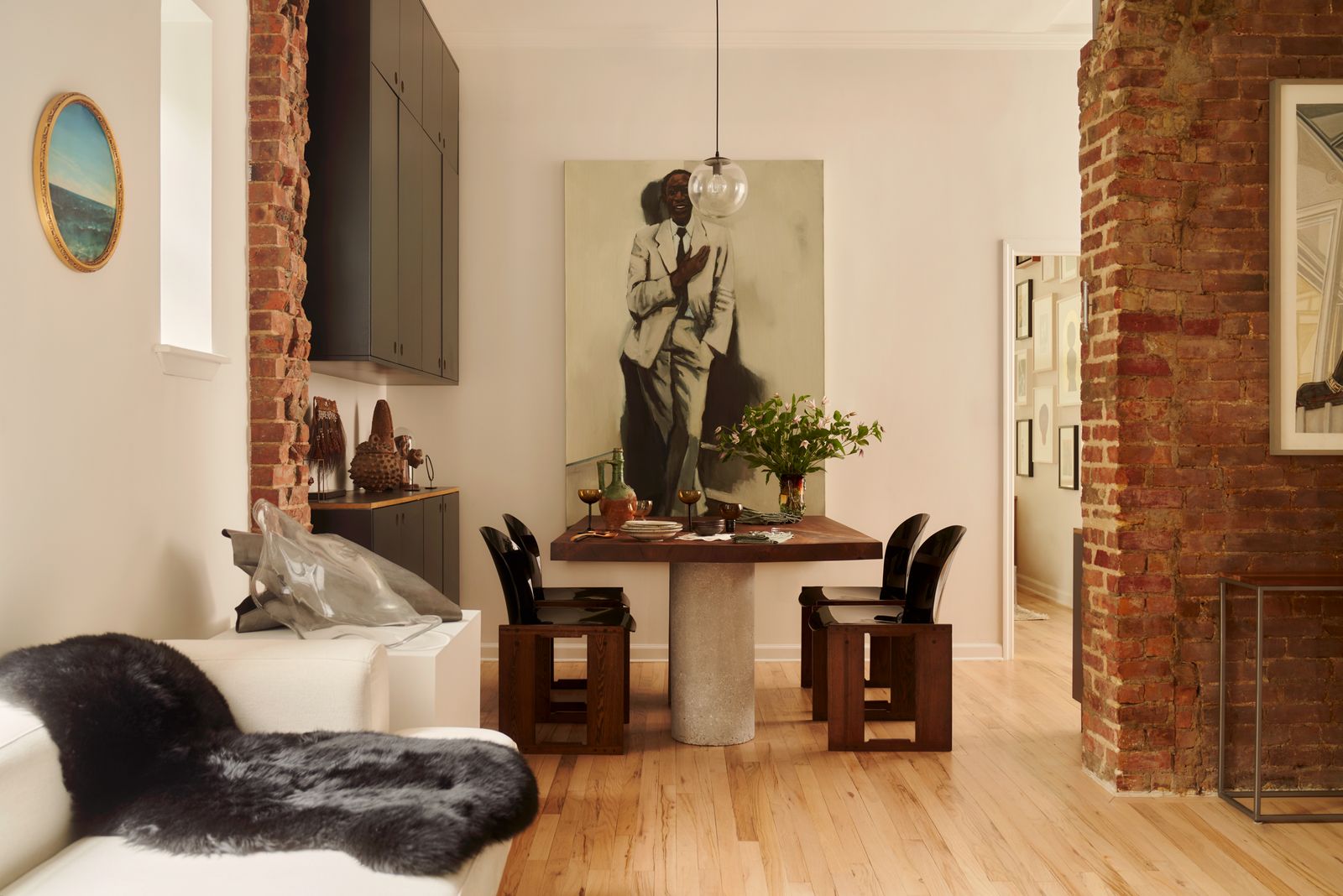
There is a productive tension between art that must be preserved and furniture that must perform. A chair with an extraordinary silhouette invites use but also raises questions of wear, finish and conservation. For collectors living with artist-designed furniture, documentation is essential: what is an edition, what is a prototype, what has been materially altered, and which elements may be restored without changing the work? A home can hold these questions more honestly than an immaculate display stand.
Bellorado-Samuels’s outlook is shaped in part by her upbringing and her father, the artist and activist Joe Sam. The objects gathered in a home seldom belong solely to the market’s idea of importance. Family memory, gifts and the history of relationships can be as important as the prestige attached to a signature. That mixture is often what distinguishes a genuinely personal collection from an expensive interior commission.
A strong home collection is not necessarily the one with the most uniform visual identity or the greatest number of museum-recognised artists. It may be the one that preserves the strongest connection between the owner’s life and the works themselves. Bellorado-Samuels’s apartment makes a persuasive case for collecting as an accumulation of relationships rather than a finished aesthetic performance.
The lessons are practical. Plan walls and lighting with actual works in mind, but allow the collection to grow rather than build an interior that can accept only one scale or type of object. Use furniture to create different distances from a painting. Record the provenance and care requirements of design objects as carefully as those of pictures. And give the home room for things whose importance is private.

A meaningful home for art should never have to pretend it is not lived in. The deepest lesson is to create room for the personal attachments that collecting gives material form.
A painting acquired from a major gallery may arrive with an exhibition history, a recognised market and a thick file of provenance. A chair made by an artist, a custom shelf or an object inherited from a parent may carry a different kind of evidence. Bellorado-Samuels’s rooms make these categories coexist without forcing everything into a single hierarchy. That attitude is more difficult to achieve than a fashionable mixture of old and new: it requires choosing objects because their stories matter, not simply because they complete a composition.
The point for an emerging collector is liberating. A home need not imitate the scale of a museum in order to take art seriously. Nor must contemporary art be accompanied only by contemporary furniture. Juxtaposition can produce greater clarity than matching colour palettes. A piece of furniture can mediate the distance from which a painting is seen, while a personally meaningful object can change what a sculpture appears to be about.
The presence of the artist and educator JoeSam in Bellorado-Samuels’s family history gives the apartment an additional dimension. His practice used found materials, text and collage to engage the politics of Black life in America. His work was the subject of Text Messages at San Francisco’s Museum of the African Diaspora in 2023–24, a significant institutional recognition of a distinctive practice that had developed over decades. The way a collector looks at an object can be shaped as powerfully by watching someone make art as by visiting the most prestigious galleries.
That inheritance should not be reduced to a decorative backstory. It helps explain a manner of collecting open to complexity, memory and political content. In a home, an artwork’s role changes with the person who lives beside it; it becomes part of daily attention rather than a remote emblem of cultural status.
Readers considering a home renovation should take particular notice of the difference between a carefully arranged room and a permanently fixed one. Serious collections evolve. Wall space should admit different sizes and mediums; electrical planning should allow for future installations; lighting should be adaptable and, where required, UV-controlled. Storage and documentation are just as important as elegant display. A generous photograph of a finished interior seldom shows these supporting systems, but they determine whether the art can live well there.
There are also boundaries to domestic informality. Sunlight, open windows, kitchen vapour and unprotected circulation routes can damage works. The productive lesson is not to sacrifice conservation to charm, but to build conservation into the architecture without making the place resemble a climate-controlled warehouse. Bellorado-Samuels’s home is memorable precisely because its objects retain distinct personalities, while the interior remains unmistakably personal.
A rare London exhibition of new works and historical material returns us to Cady Noland’s uncomfortable vision of American spectacle, power and the ordinary object.
A gallerist’s Clinton Hill apartment reveals how painting, sculptural furniture, family history and unorthodox choices can make a home feel genuinely collected.
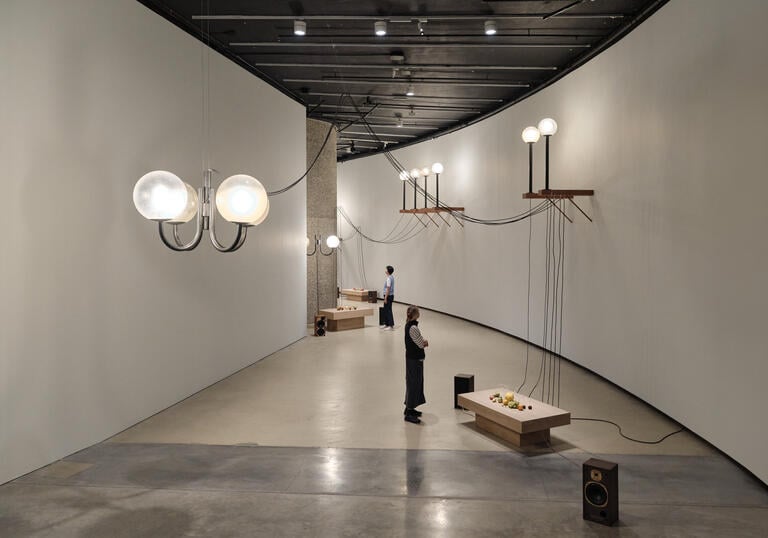
With light, sound, fruit and kinetic systems, Yuko Mohri makes the Barbican’s Curve into an argument for attending to what does not quite work as expected.