Go Back
Magazine

Artist interview with Sophie-Yen Bretez

Following her selection as the latest ARTCOLLECTORNEWS Open Call winner, Sophie-Yen Bretez discusses the ideas that underpin her practice, the relationship between material and memory, and the importance of creating work that invites sustained reflection. Rather than following trends, Bretez's work unfolds through careful observation and a nuanced engagement with contemporary experience. This exclusive interview offers collectors an opportunity to discover the artist behind the work and the thinking that continues to shape her evolving practice.

Art Collector Interviews
Artist interview with Sophie-Yen Bretez

Winner of the latest ARTCOLLECTORNEWS Open Call, Sophie-Yen Bretez has developed a practice that navigates the space between memory, materiality and human experience. In this exclusive interview, she reflects on the ideas, processes and influences that shape her work, offering collectors and contemporary art enthusiasts a deeper understanding of an artist whose thoughtful approach is attracting increasing attention.

ARTCOLLECTORNEWS: Please tell us a bit about yourself and your artwork?

I'm a Franco-Vietnamese self-taught painter based in Paris. I was born in Vietnam and was adopted at 4 by French parents. Even if my story isn't the direct subject of my painting, it’s its inner matrix as it has shaped the way I perceive the world and has brought forward questions that constantly run through my work about memory, time, place, identity…

My figurative painting comes from a pretty simple desire: to translate into images a symbolic, sensory and existential relationship to the world. I develop a visual vocabulary to build spaces that don't quite belong to reality. They belong to an uncertain temporality where memory, the present, vitality, loss and nostalgia can coexist within the same scene. I try to create another world, one in which physical space is an extension of mental space, where objects are capsules of memory and landscapes are witnesses to passing time and to the memory that remains. There is always an underlying ambivalence and tension in my painting. Words are also part of my practice. I write alongside painting, with the same sensory and symbolic approach. Some poems become the titles of my works. Little by little, I'm consolidating a personal alphabet made of images, colours, symbols, which allows me to give visible form to complex inner sensations.

"Before we knew there was silence the mountain spoke the water answered the world remembers, for us."              150x110cm; Oil on linen, 2025

ARTCOLLECTORNEWS: What first inspired you to become an artist?

I began painting during lockdown, in my Paris apartment. At first, I painted scenes with horizons, perhaps because I didn’t have any from where I lived. Painting arrived at a moment in my life when there were maybe too many things inside me asking for a form. That moment also coincided with very significant intimate events: the death of my adoptive father, a serious health episode and older questions related to my adoption story. I don't think I became an artist through a perfectly conscious decision. At first, I painted simply because I needed to. Then, little by little, that need became a language, then a practice…then a life, almost without me realising it. My first solo show in 2023 was then a decisive moment because it forced me to understand concretely what this practice required: discipline and a total commitment.

ARTCOLLECTORNEWS: How has your background shaped your artistic practice? Are there other influences to your work? Literary, artists, travel, autobiographical?

There is a double dynamic in my background: my artistic practice is deeply nourished by my personal history but it has also been structured by my academic and professional path.

I began oil painting in 2021, after preparatory classes, business school and several years working in communications. That background gave me a relationship to rigour, endurance, methodology and the ability to structure a thought or a project. Painting, on the other hand, came from a much more instinctive and vital place. It opened a space that traditional frameworks were no longer able to contain. As soon as I accessed this language, an entire world was opening up to me: the world of inner life, of memory, of my own history. The more I painted, the more I understood certain things about my personal journey. And the more I understood, the more new layers of reading appeared, which I then tried to make tangible through painting.

My adoption story is obviously important in this construction. It’s tied to a displacement from one country to another, to the loss of a language, of a place of origin and of a sense of continuity. My painting tries to make tangible the sensation of being between several places, temporalities and versions of oneself. As time goes on, I feel more and more that I’m trying to make visible the aftermath: how to inhabit the world from within the fracture.

My practice is also nourished by philosophical and literary readings, which have often accompanied me for years. I often return to authors who question identity, memory, exile, the body, time and space, such as Paul Ricoeur, Annie Ernaux, Albert Camus, Marguerite Duras, Virginia Woolf or Gaston Bachelard. 

ARTCOLLECTORNEWS: How has your creative process and artwork changed over the years?

At the beginning, my relationship to painting was much more direct and frontal. I had to get an image out of my head quite immediately. There were already motifs that still return in my work today: the female body, an interior, a window, a horizon. In my first solo show, in 2023, I was mainly driven by questions of identity and femininity. The figures were often very frontal, very naked. Over time, my work moved towards a much more conscious, more architectural construction. The question of time also became central. I began to build my compositions as fragmented spaces, with several points of view, several regimes of light and colour, several emotional states within a single image.

My process has therefore evolved towards a more complex painting but with the same necessity: to translate sensations, contrasts, states of ambivalence. Paradoxically, even though my work is now more constructed, I also leave more room for what wasn’t planned. Before, my paintings were often decided very early on, entirely structured by the sketch. Now, I accept more readily that texture, colour, layers and accidents on the surface can shift the image as I work. There is therefore more control and more surrender at the same time.

ARTCOLLECTORNEWS: Are there any particular artists or movements that have greatly influenced your work? In what way?

This is a question I always find a little difficult to answer in a linear way because I don't feel that I have been influenced by a movement or by a painter in a direct sense. I think my relationship to influence works more through affinities and dialogue. As a child, I was exposed very early on to modern painting, to the Impressionists, to a certain history of colour and looking. But I don't know whether these works influenced me because they were there, or whether they already spoke to me because my eye naturally gravitated towards colour, light and atmosphere. There is always something slightly mysterious in the formation of a gaze and of taste.

So I wouldn’t say that I work from influences in the strict sense, but rather from a constant dialogue with works. I look for texts, images and thoughts that move me because they answer something within me. Then I transform them into painting.

ARTCOLLECTORNEWS: How did you arrive at your style? What can you tell us about your individual style and visual language?

My style didn’t appear in a completely conscious or voluntary way. It appeared through repetition, through forms, colours and motifs that kept returning like obsessions. Over time, I understood that these elements were the beginnings of a language. From my very first paintings, certain foundations were already there: horizons, windows, interiors, female figures, colour contrasts, an attention to harmony and structure. At first, I may have approached them more instinctively. Then I understood that these choices translated my way of perceiving the world. So my style was born from repetition and a constant dialogue with myself. The more I paint, the more this language becomes richer, more precise and more complex. I would describe my visual language as symbolic and poetic figuration. What interests me is the coexistence between a form of seductive visual softness and deeper existential or philosophical questions.

ARTCOLLECTORNEWS: How do you select your themes or subjects for each painting?

I don't really choose the themes of my paintings in a rational way. Sometimes I think first through images (a scene, a line, a structure…). Then, little by little, I bring that image into dialogue with the themes that keep coming back in my work: time, space, identity, memory, absence, presence or belonging.

Other times, it starts with words. A sentence I wrote in a notebook, a word, a fragment, or a sensation that stays with me. Sometimes one word is enough, and the painting begins to build itself around it. For my next solo show, for example, I found expressions in my notebooks that have stayed in my mind: “the country of others”, “a place without a place”, “for another land”, “adrift”. They have become part of the vocabulary of this new body of work. Some paintings clearly echo those phrases, even if they don’t illustrate them directly.

So I gather images, words, sensations, recurring motifs, and I try to understand how they can exist together. A shower, a table, a window, a bed, a landscape become places where larger questions begin to gather. Each painting opens a more precise question inside something much broader. 

ARTCOLLECTORNEWS: Please tell us about your latest body of work

My latest series of works, presented during my solo show at JD Malat Dubai in 2025, was very much about memory and the way memory remains. In this body of work, I started to expand my pictorial world by moving memory beyond the body alone. Memory began to pass through objects, landscapes, natural elements such as a bitten fruit, an overturned glass, a flowing river, a plate, a tree, a letter could become capsules of memory, like traces through which something buried could return. I think this series was crossed by a kind of “dramaturgy of passage”. You could feel that a life had taken place, that something was shifting, that a change was underway, or that something had already begun to disappear. The scenes often felt caught between several temporalities contaminating one another. 

Installation view at JD Malat, Dubai

Colour was also very important in this series. It was vivid, saturated, sometimes almost violent. I worked a lot with glazes, chromatic tensions, and contrasts between very luminous areas and colder zones, which began to appear as signs of disappearance. There was a strong vitality in these paintings, something joyful or seductive on the surface but crossed by something more subterranean and ambivalent. Looking back, I see this body of work as a staging of memory. It was about showing how the past contaminates the present.

ARTCOLLECTORNEWS: Lately you have started working on landscapes beautifully as the sole focal subject matter as well.  Can you tell us a bit more about this?

Landscapes have long been present in my paintings, but often as rather stripped-down horizons in dialogue with the figures. Recently, I felt the need to confront the landscape alone, to see how my themes could exist without the human figure. It was a kind of test for my language: how to speak about time, memory, space or identity without passing through a body? How can a tree, a river, a mountain, the wind or water carry, on their own, an existential and symbolic charge linked to origin, passage, rootedness, absence and transformation?

I wanted to explore that power and to see how my painting could continue to build new metaphysical spaces through landscape.

ARTCOLLECTORNEWS: Do you have any upcoming exhibitions or projects that you are excited about?

I'm very excited to present my new body of work in the United States. I have a presentation project at Untitled Miami next December, as well as an upcoming solo show with Johansson Projects in Oakland. Another exhilarating year ahead.

Detail of a painting of Sophie-Yen Bretez upcoming Solo show at Johansson Projects 2027

ARTCOLLECTORNEWS: What do you think is the most important aspect of creating successful artwork?

It is a difficult question because one would first have to define what a “successful” work of art means. Is it successful because the artist has managed to say what they wanted to say? Because the public understands it or because it is acclaimed by critics? Because it deeply moves someone, even in a way that differs from what the artist had imagined?

Personally, I often find it difficult to know immediately whether a painting is successful. When I'm in constant contact with a work during its creation, I lose a certain distance. I can know whether something works pictorially, in terms of composition, and colour but the feeling that a work truly exists often comes later, with distance, sometimes months or even years afterwards.

I believe that a successful work is first of all a work that comes from a real inner necessity. The process can be very constructed or more instinctive, but that isn't what determines its success in my eyes. What matters is that the impulse is right, deep and sincere, and that the work doesn’t explain everything.

Perhaps it is, on the contrary, a work that continues to act, to open a space of sensation, thought or disturbance in the person looking at it. Some works I now consider successful remain partly inaccessible to me as they continue to resist me.

"It is born of a strange equation. Numbers adrift ,a fleeting trace It is the echo of time  In the curve of my face."        100 x70cm, Oil on linen, 2025

ARTCOLLECTORNEWS: Could you please describe your process of creating a new artwork from concept to completion for us?

The conception of a work always begins with a long silent dialogue with myself. I need several days, sometimes several weeks, to digest what I want to explore in a new body of work. When something becomes clearer, I begin to draw at home. It is almost impossible for me to conceive a sketch anywhere other than in my apartment. My studio is the place of the body, of production. My apartment is a more inward place, more connected to thought, emotion, comfort and conception. It is where most of my sketches are born. I often begin with very small pencil drawings, to see whether the composition holds. Then I make a coloured pencil sketch in a slightly larger format, often in one go, to feel the first harmonies, masses and chromatic tensions. Then I move on to the digital sketch, where I define the overall architecture of the image more precisely. There is also something very physical in this conception phase. For digital sketches, for example, I often need to be in a bed or on a sofa. I can’t really make them at a table. I need to be in a more relaxed, more interior state before the image is taken up again by the more frontal and physical work of the studio. 

Once this structure is in place, I move on to painting. The work is made over several weeks through successive layers. I gradually build the colours, textures, transparencies, backgrounds and details until the painting finds its balance. At the same time, I keep a production journal where I note the time spent, the different stages and the layers I have made so that it allows me to understand more concretely the rhythm of my work and the way each painting is built over time.

ARTCOLLECTORNEWS: What has been the most memorable artwork you have created? What makes this piece memorable?

The most memorable work I have created so far is probably the large shaped quadriptych dedicated for my last solo show at JD Malat Dubai in 2025. The frames were handmade in Paris, in solid wood by an art cabinetmaker. I wanted the structure itself to already be a meeting point between craftsmanship, sculpture and painting. It remains very important to me because it was at once the largest, most complex and most ambitious work I had ever made. What is strange is that I don't know exactly how this image came to me. For this work, despite the technical complexity, the stress, the constraints of fabrication and composition, I had a very strong certainty: I had to make it.

This piece is also memorable because it condenses almost all of my vocabulary. We follow a character over the course of a day, as a metaphor for existence. There is the interior space, with the bathroom and the kitchen, the exterior space with the landscape, and then, in the lower part, a large banquet without any human figure. In this banquet, there are twelve plates, like the twelve hours of the day. Each plate contains a food charged with autobiographical, symbolic or temporal meaning. On the table, some objects are bitten, overturned and already consumed. One feels that a life has taken place but it has already passed. That is why I think of this work as a banquet of absence.

It was difficult to produce but it also marked a new step in my practice. It showed me that I could move towards more ambitious and more architectural forms.

ARTCOLLECTORNEWS:  Can you tell us a bit about a few specific pieces you have created that you are particularly proud of?

The works I'm particularly proud of are often those that opened a new territory in my practice without breaking away from my language. They allowed me to measure a progression, both in my painting and in my relationship to my own history.

I’m thinking in particular of several works built around the table, the game, exchange and transaction. These are scenes that have returned in my work for several years, almost like the same inner image that I replay and reinterpret in different forms. The table becomes a place of confrontation, memory, chance and fate. In a way, it also embodies something very personal for me because it was around a simple table that my life changed when I was four.

In a first work from my 2023 solo show, the composition is seen from above, in a very frontal way. The body, objects, cards, food and autobiographical fragments are placed in a very direct space. Then, in works from 2024, several points of view begin to coexist: one figure may be seen frontally, another from behind, another from above. This shift was important to me because it allowed me to complexify the pictorial space and bring several perceptions into the same scene.

For my 2025 solo show, this scene transformed again. The space became more fragmented around the figures. Landscape, temporalities, objects, books, cards, and symbolic elements took on a more important place. It was a kind of interior theatre where several levels of reading could coexist.

I'm particularly attached to these works because they speak of the game as an existential metaphor. All the elements connected to the game become a way of speaking about chance, risk, loss, about what is at stake in a life before one can truly choose. What moves me in retrospect is that some images appeared almost unconsciously, as with the shaped quadriptych. They sometimes seem to have come out of my head with a form of obviousness, even though my process is very constructed. This part of mystery gives these works a particular tone. 

"Time is the seas’ expanse.  Time, it is all in one.  And in its womb, the sun abundance."                120x160cm, 2024 , Oil on linen

ARTCOLLECTORNEWS: What themes or topics are you exploring in your current artwork?

In my current works, I’m working around the notion of habitability: the habitability of the body, of space, of time, of identity and of the world. This question came after my return to my native village in Vietnam. At first, I thought I wanted to speak about exile, about returning to one’s origins, perhaps even about a form of repair. But once I was there, I understood that an original repair wasn’t possible. Returning to the source doesn't erase the rupture, nor does it make whole again what has been separated.

The previous body of work staged memory: its emergence and its returns. The one I’m developing now begins from another question: how can one inhabit what remains after this return of memory? How can one live not despite the fracture, but from within it? In these new works, the body is never fully given. It can appear, disappear, dissolve into water, light, a surface, or be replaced by a cartography, a landscape, an inner geology. The spatial question returns differently: the place, the origin, the map, the ground, the surface, what allows or prevents one from inhabiting. This is also why I’m now integrating different regimes of texture. Alongside the smooth surfaces that already belong to my language, I introduce rougher materials, sand, grains of varying fineness, surfaces that seem worn down, hollowed out, geological. By integrating these new regimes of texture, I continue to deepen a central question in my work: coexistence. The coexistence of places, temporalities, colours, memories, materials, states of the body. This coexistence also passes through the skin of the painting, through what wears away, settles, is hollowed out and remains. 

ARTCOLLECTORNEWS: Are there any projects or themes you would like to explore in the future?

I would like to continue exploring what my own history brings me, and sometimes forces me to think about in relation to the world. I feel that I’m still at the beginning of this exploration. For now, painting remains my main language but I also have mental images connected to other forms: installations, sculptures, perhaps objects or spaces that could physically extend the questions I'm already working through in my paintings. Since my work speaks so much about space, interiors, landscape and inhabiting, it feels natural that one day these concerns might move beyond the frame of the canvas and become more immersive environments.

It isn't about changing medium for the sake of changing medium. It’s much more about seeing how each form can deepen a question. How could a sculpture speak about the body or memory? How could an installation make the notion of habitability perceptible? My work will continue to build itself around the same necessity: transforming an intimate history into a visual language and seeking to make visible complex sensations connected to the themes that are dear to me.

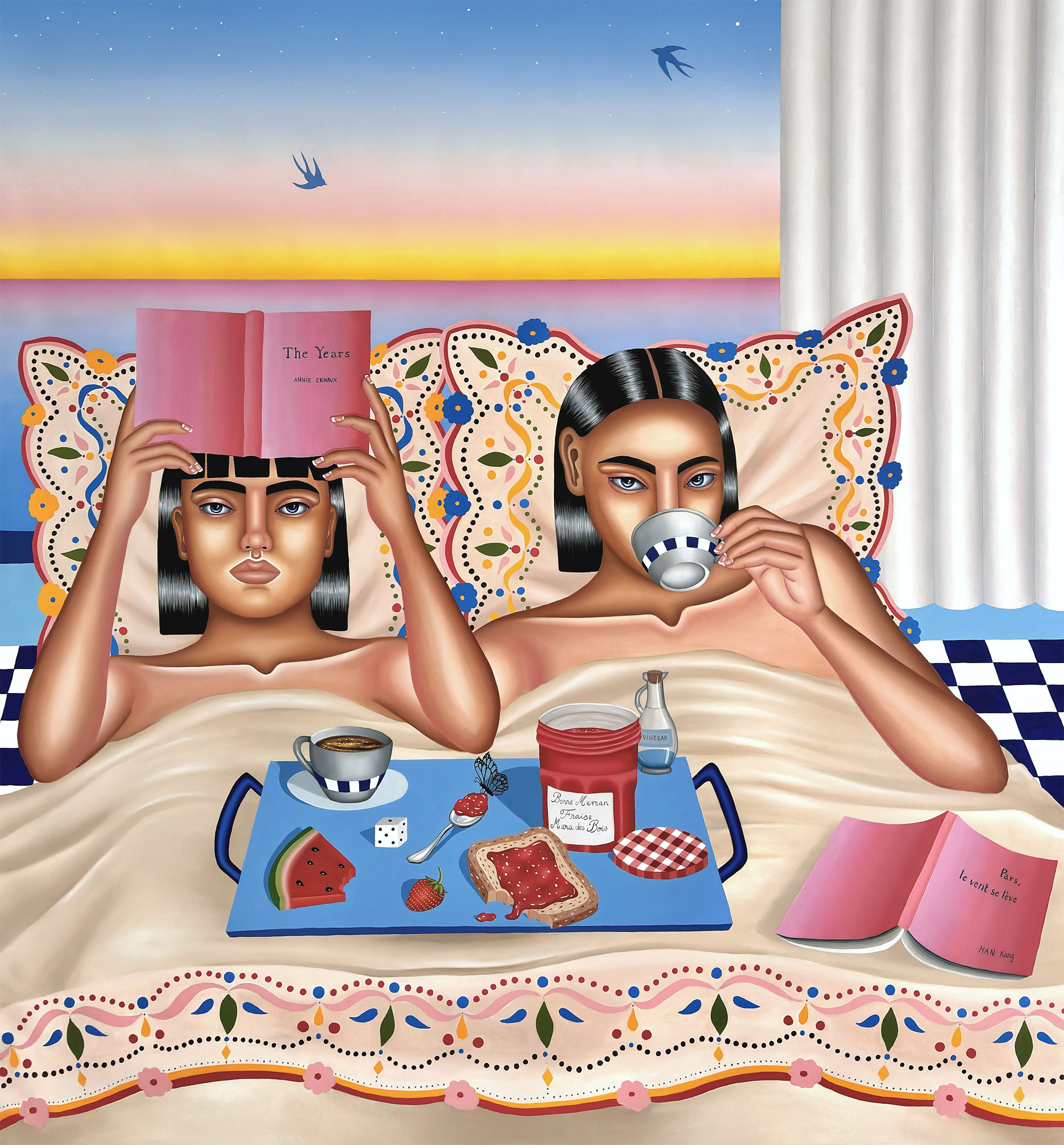
"And yet, the morning holds its place, Absurd still full, a silent plea, Insisting on beauty's senseless grace, Calling to be embraced endlessly."          124,5 x 114,3cm, Oil on linen, 2024"

ARTCOLLECTORNEWS: What do you think is the most important skill a studio artist should have?

Discipline as an ability to return, to continue in contact with one’s practice even when one doubts, even when one doesn’t yet know exactly where one is going. It’s through doing that one learns and through continuing to do that one enriches one’s language. For me, the most precious resource an artist has is time. A studio artist must know how to protect that time. They must accept that certain things only reveal themselves through work, repetition, patience and a full presence.

ARTCOLLECTORNEWS: What do you think has been the biggest challenge in your creative career?

My greatest challenge has been to give doubt its rightful place. Doubt can be very fertile when it forces you to remain humble, to look at your work with rigour, to question yourself and not settle into a form of comfort. It can allow you to keep searching, to shift your language, to avoid mechanically repeating what you already know how to do.

But doubt can also become paralysing if it takes up too much space. It can prevent movement, boldness, the confidence needed to take a work or a vision all the way through. For me, the challenge is therefore to find that balance: to keep doubt alive enough to remain lucid and demanding, but not to the point that it suffocates the creative impulse.

One also has to keep the ego at the right distance. If it’s too present, it can make one deaf to the work itself. But if it’s too absent, one can lack the courage needed to affirm a direction or an intuition.

ARTCOLLECTORNEWS: What advice would you give to aspiring studio artists?

I don't know whether I’m already in a position to give advice. I'm still a young artist, and I constantly feel that I'm learning. But if I had to share something from my current experience, it would be to protect your time, your energy and your resources. Being an artist requires much more than producing works. It requires time to search, to fail, to begin again, to think, to build a language. It also requires a certain discipline and material lucidity. Time and money are very concrete resources in a studio practice, and one has to learn how to protect them. One also has to accept that the work is built over time. It is tempting to want to go fast, to compare oneself, to answer every expectation, to seek visibility very early. But what truly grounds a practice is the time spent with it, in the studio, in doubt and in repetition.

So perhaps I would say: protect what allows you to continue. Your time, your energy, your curiosity, your sincerity and the part of solitude that is necessary for your work.

Date
Aug 3, 2026
Share

Latest Posts

Artist interview with Sophie-Yen Bretez

Following her selection as the latest ARTCOLLECTORNEWS Open Call winner, Sophie-Yen Bretez discusses the ideas that underpin her practice, the relationship between material and memory, and the importance of creating work that invites sustained reflection. Rather than following trends, Bretez's work unfolds through careful observation and a nuanced engagement with contemporary experience. This exclusive interview offers collectors an opportunity to discover the artist behind the work and the thinking that continues to shape her evolving practice.

July 20, 2026
Articles
Articles
The New Curators of Art History: How Museums are Quietly Redefining what Future Generations will Collect

The most influential decisions shaping the future of art are rarely made in auction rooms or beneath the glare of international art fairs. They happen quietly, often behind the closed doors of museum acquisition committees, curatorial departments and scholarly research centres. As museums around the world rethink what they collect and why they collect it, they are doing something far more significant than expanding their collections—they are redefining art history itself.

July 16, 2026
Articles
Articles
Claude Monet's Early Masterpieces Reunited in France: Rare Exhibition Offers Fresh Insight into an Impressionist Legend

Collectors with a passion for Impressionism have a compelling reason to look toward Normandy this summer. The Musée d'Art Moderne André Malraux (MuMa) in Le Havre has assembled approximately one hundred early works by Claude Monet, revealing the artist's remarkable development before the emergence of Impressionism.