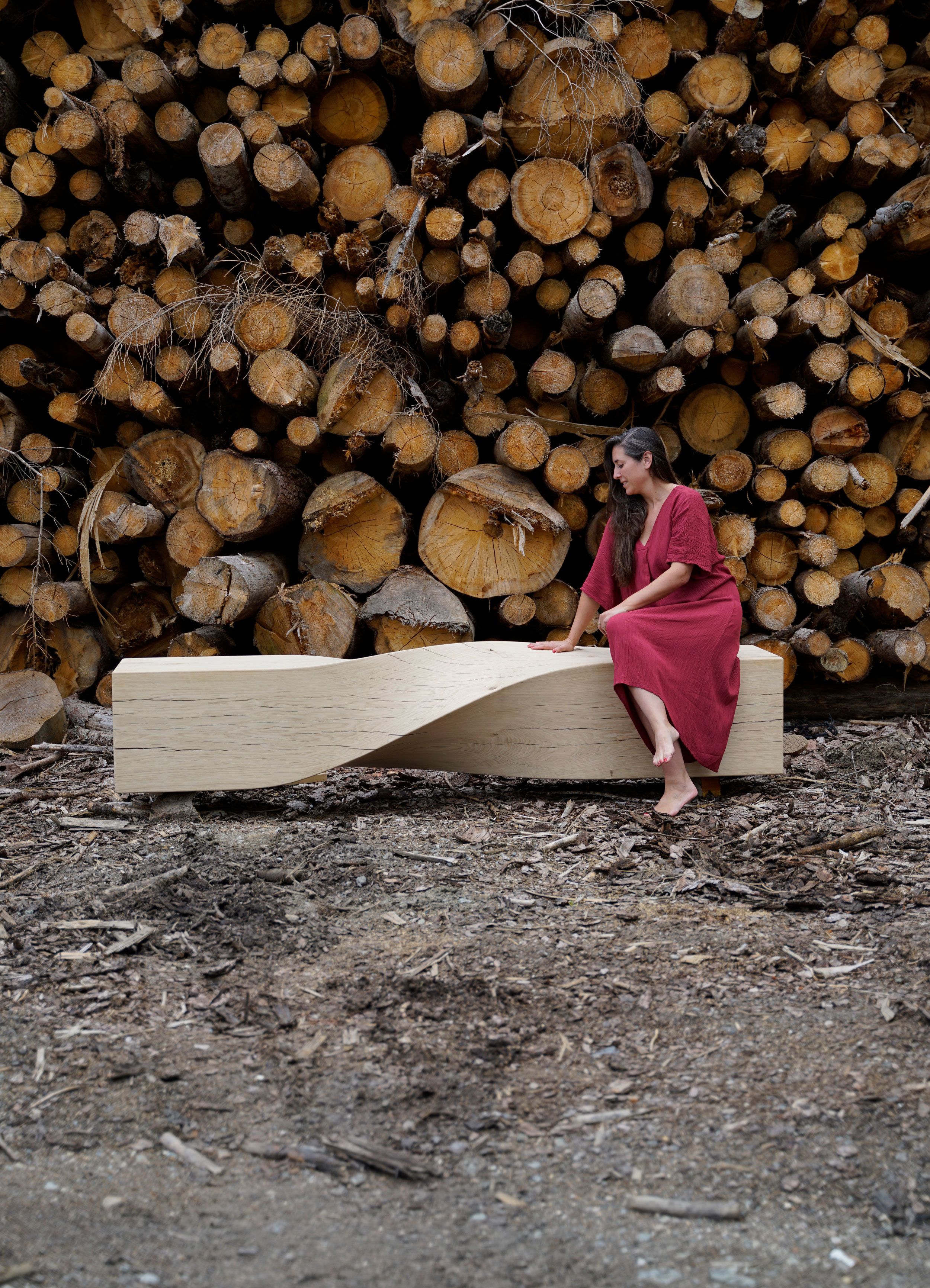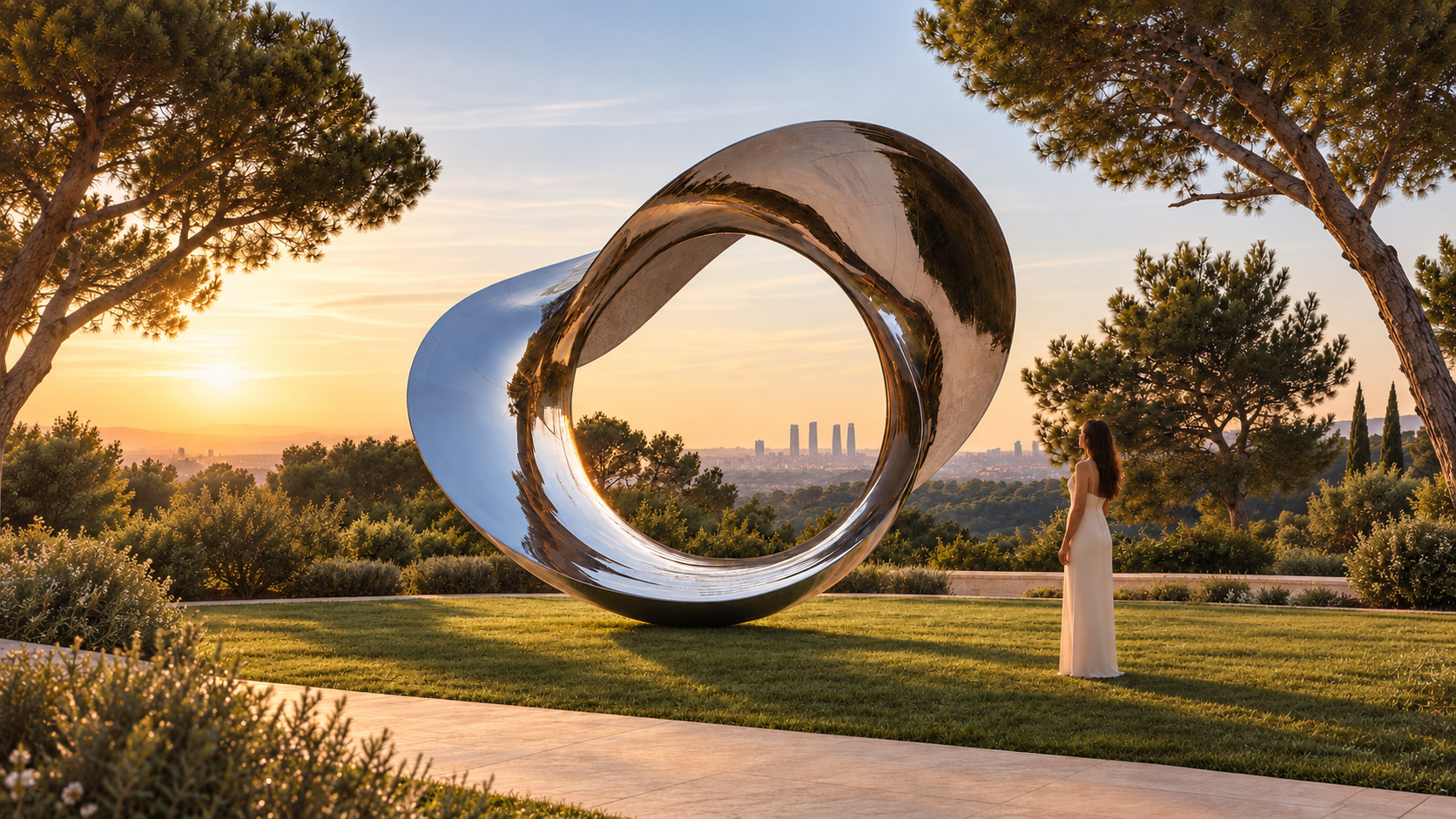
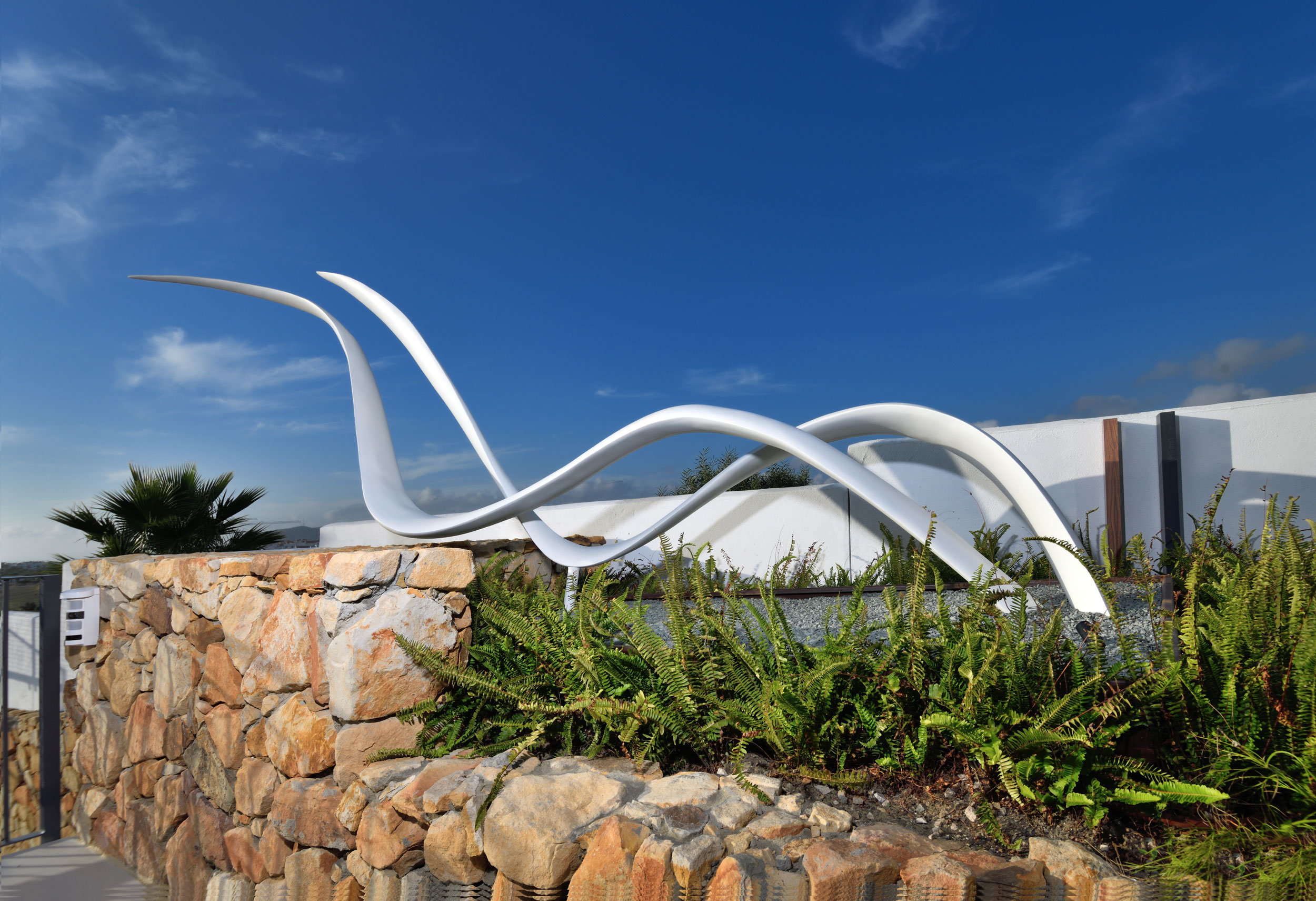
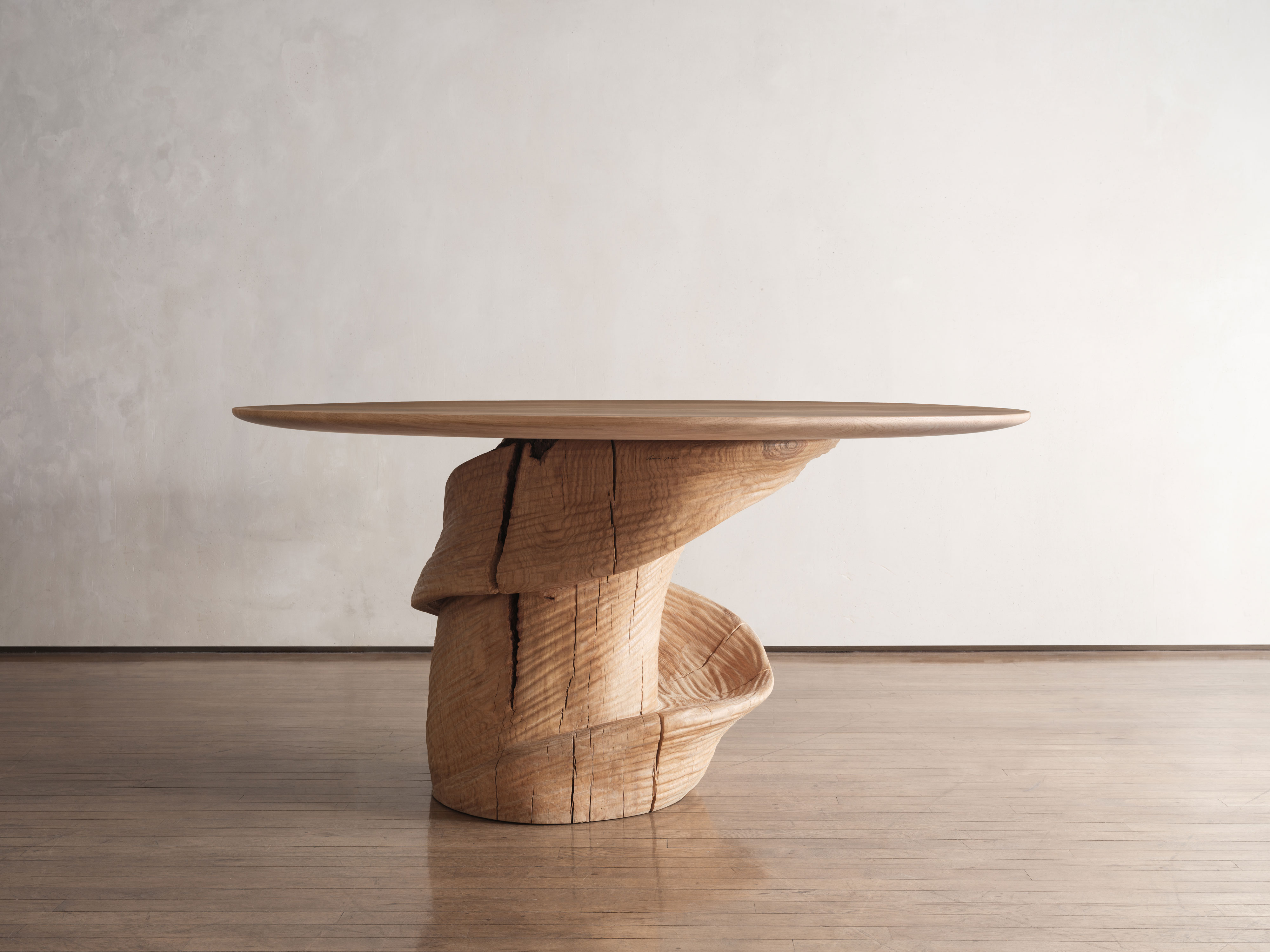
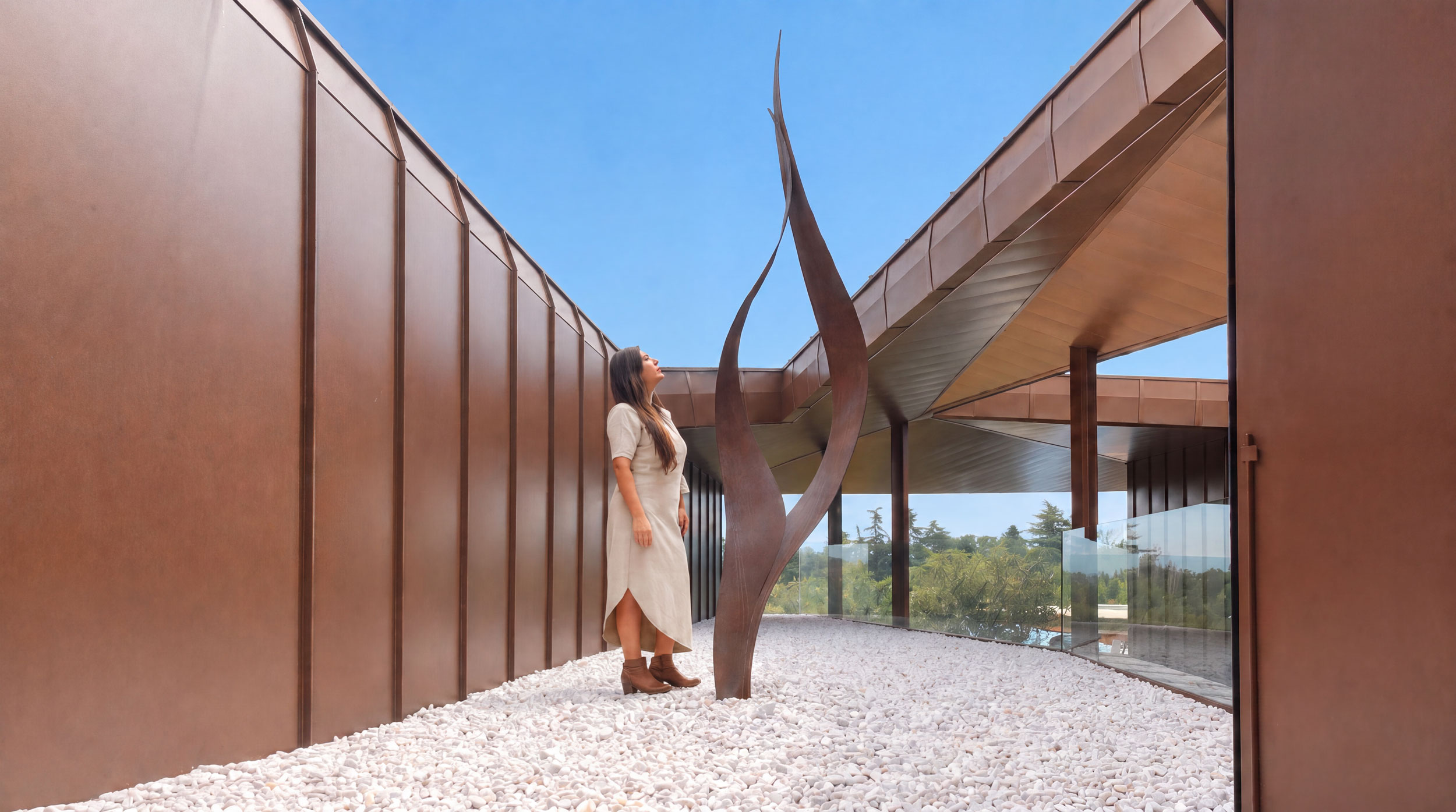
In an extensive interview, Spanish sculptor Verónica Mar discusses UNIVERSO in Madrid, her evolution from sculptural furniture to monumental portals, and the relationship between form, space and the invisible.
Verónica Mar: From Nature to Essence
In an extensive interview, Spanish sculptor Verónica Mar discusses UNIVERSO in Madrid, her evolution from sculptural furniture to monumental portals, and the relationship between form, space and the invisible.

Introduction
For Spanish sculptor Verónica Mar, the evolution of an artistic language has been a process of reduction: stripping away the recognisable forms of nature to arrive at something more essential. Across nearly two decades, her work has moved from sculptural furniture inspired by the organic world towards increasingly abstract compositions concerned with movement, equilibrium and the relationship between matter and space.
Born in Granada in 1979 and based in Madrid, Mar studied interior design at EINA in Barcelona before completing a degree in Fine Arts at the University of Barcelona. Her early creations, including the celebrated Soul Sculpture Bench and Autumn Leaf Swing, established a distinctive approach to collectible design, combining functionality with fluid, sculptural forms. Since then, her practice has expanded internationally, with presentations through galleries including Rossana Orlandi in Milan and Ateliers Courbet in New York. In 2025, she received the Ciudad de Badajoz Sculpture Prize for Unity Enzo, recognition of her increasingly independent sculptural practice.
Her current exhibition, UNIVERSO, which opened at Gärna Gallery in Madrid on 10 September 2026, brings together works spanning almost twenty years. More than a survey of changing styles, the exhibition reveals the continuity of an artistic investigation. Natural forms give way to abstraction; separate elements that once suggested opposing forces evolve towards circular compositions expressing unity, and eventually towards portals that invite the viewer to consider the space within and around the sculpture itself.
Central to this progression is Mar's engagement with sacred geometry and traditions concerned with the relationship between human experience and the built environment. Drawing on geometric proportion, spatial harmonisation and spiritual philosophies, she approaches sculpture as something capable of shaping the atmosphere of a place, rather than simply occupying it. Her works, which she describes as Totems of Light, reflect an ambition to give physical form to qualities she considers intangible: energy, balance, presence and connection.
Materiality remains equally important. Whether working in marble, bronze, timber or Cor-ten steel, Mar seeks to reconcile substantial physical materials with an impression of movement and lightness. Her collaboration with specialist craftspeople is integral to this process, as is her ongoing exploration of the relationship between contemporary sculpture and collectible design.
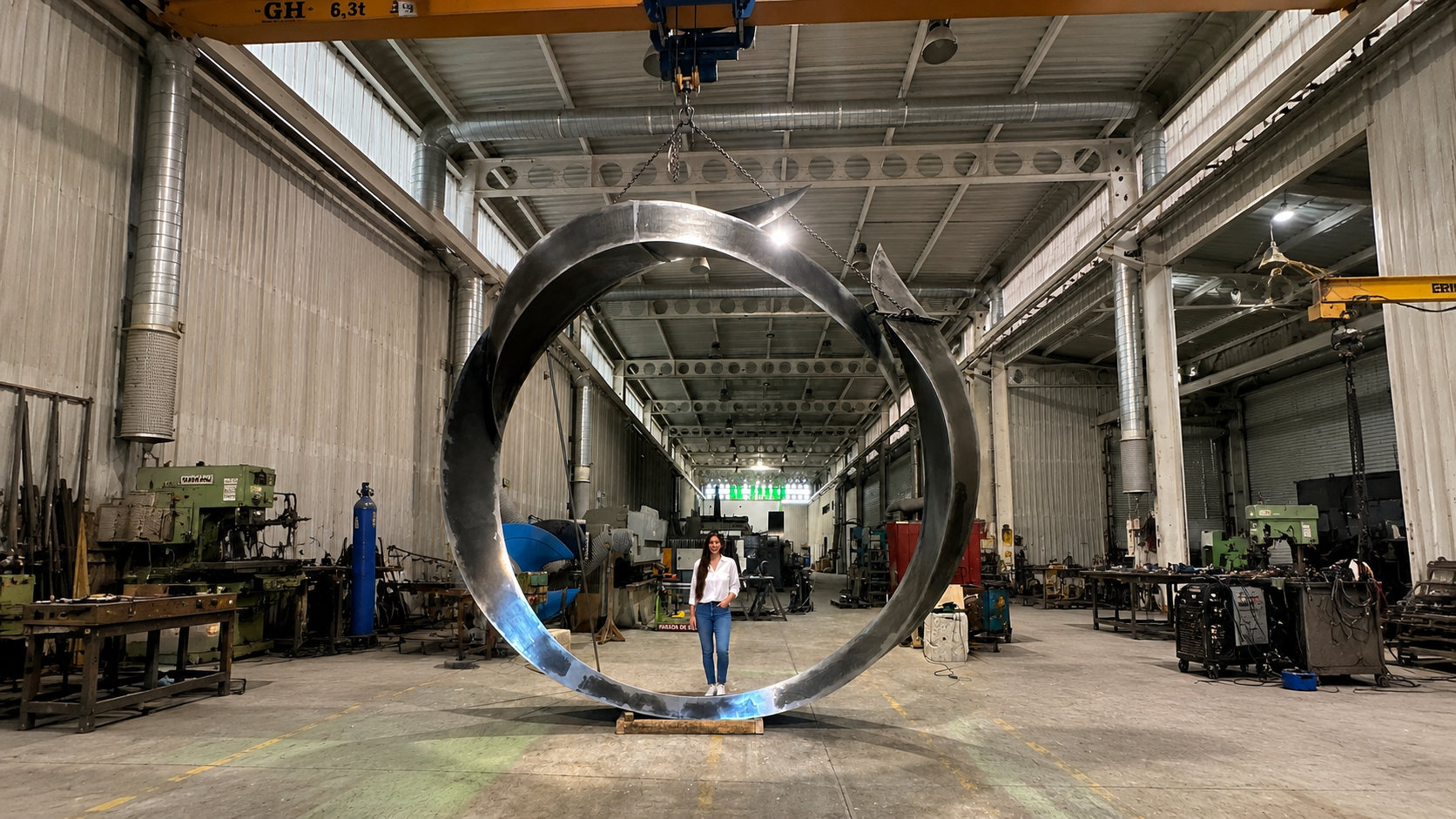
A new chapter is now emerging. In 2026, Mar presented ENSO GATE, a monumental Cor-ten steel sculpture, in the public exhibition The Art Square at Brussels' Square Armand Steurs. Further large-scale projects are being developed for architectural and private settings, extending her practice beyond the dimensions of the gallery and into spaces experienced and inhabited by others.
For collectors, architects and those interested in the evolving relationship between art and design, Mar's work raises compelling questions. How does a sculpture establish a dialogue with its surroundings? What happens when an object becomes an experience? And how might the most significant element of a sculpture be not the material from which it is made, but the space it leaves open?
Against the backdrop of UNIVERSO, ARTCOLLECTORNEWS explores the ideas, influences and ambitions shaping Verónica Mar's artistic world.

In Conversation with Verónica Mar
UNIVERSO: Looking Back, Moving Forward
ARTCOLLECTORNEWS: Your exhibition UNIVERSO brings together almost two decades of work, from your earliest collectible designs to your recent abstract sculptures. Looking at these different periods together, what surprised you most? Do you see a continuous artistic language running through them, or are there moments when you feel you became a fundamentally different artist?
What surprised me most was discovering how deeply everything was connected. When you are immersed in the creative process, you don't always recognise the direction you are moving in. Seeing works from almost twenty years together, I realised that the questions I was asking at the beginning are, in essence, the same ones I am still exploring today. I began by drawing inspiration from nature, and in some of those first pieces you can already see the same forms that appear in works created twenty years later. My aim of reaching the essence of form was also an aim of reaching the essence of matter, energetically speaking.
There has always been a search for harmony, balance and the energetic transformation of space, even when my work was more recognisably inspired by nature, as with the Ginkgo collection or the Leaf swing.
What has changed is the depth of that inquiry. In my early work I was interested in the visible expression of natural forms. Today I am increasingly concerned with the invisible principles that organise them.
For me, UNIVERSO is not simply a retrospective. It is the visual expression of an inner evolution, in which the pieces speak to me about what I need to do in my life to be happy and at peace.
ARTCOLLECTORNEWS: The phrase From Nature to Essence seems particularly appropriate to your evolution. Early works such as Autumn Leaf Swing and Soul Sculpture Bench draw visibly on natural structures, while your more recent sculptures have become increasingly abstract. What prompted that transition? Was there a particular work or moment when you realised you no longer needed to represent nature directly?
Nature has always been my great teacher, but over time the way I observe it has changed.
At first I was fascinated by its visible forms: the movement of a leaf, the growth of a tree, the curves of the human body, the spirals and rhythms present throughout the natural world.
Gradually I became more interested in what all those forms have in common. Why do certain proportions appear again and again in nature? What creates the feeling of balance? What remains when we remove everything that is not essential? How can a particular form, with precise measurements, change the energy of a space? I began studying Feng Shui, Vastu Shastra and sacred geometry — knowledge kept hidden for centuries and used by every ancestral culture, applying the sacred geometry of the place to create buildings, pyramids, cathedrals and monuments that generate the highest vibration.
Through works such as SOUL and, later, the UNITY series, I began moving away from recognisable references towards a more universal sculptural language, in which I expressed the balance between the two energies present in everything that exists: yin and yang, light and shadow. We all carry both energies within us.
Sacred geometry became especially important in that process. It offered me a way of understanding nature beyond its physical appearance.
I realised I did not need to reproduce nature in order to express its essence. I could work with the principles that give rise to its forms — and, above all, there was the satisfaction of knowing that a specific measurement can change the energy of a space.
My journey could be described as a movement from the beauty of nature towards the intelligence that resides within it.

ARTCOLLECTORNEWS: You trained in both fine art and interior design, and your early career challenged the boundaries between sculpture and functional objects. Today, your practice moves between collectible design and autonomous sculpture. Do you consider these distinct disciplines, or have you always regarded them as different expressions of the same artistic investigation? What, if anything, changes when a sculpture must also function as a chair, a table or a bench?
I have never felt a clear separation between art and design.
My training in interior design taught me to understand space, proportion and the relationship between objects and the human body. Fine Arts gave me greater freedom to explore those relationships beyond function.
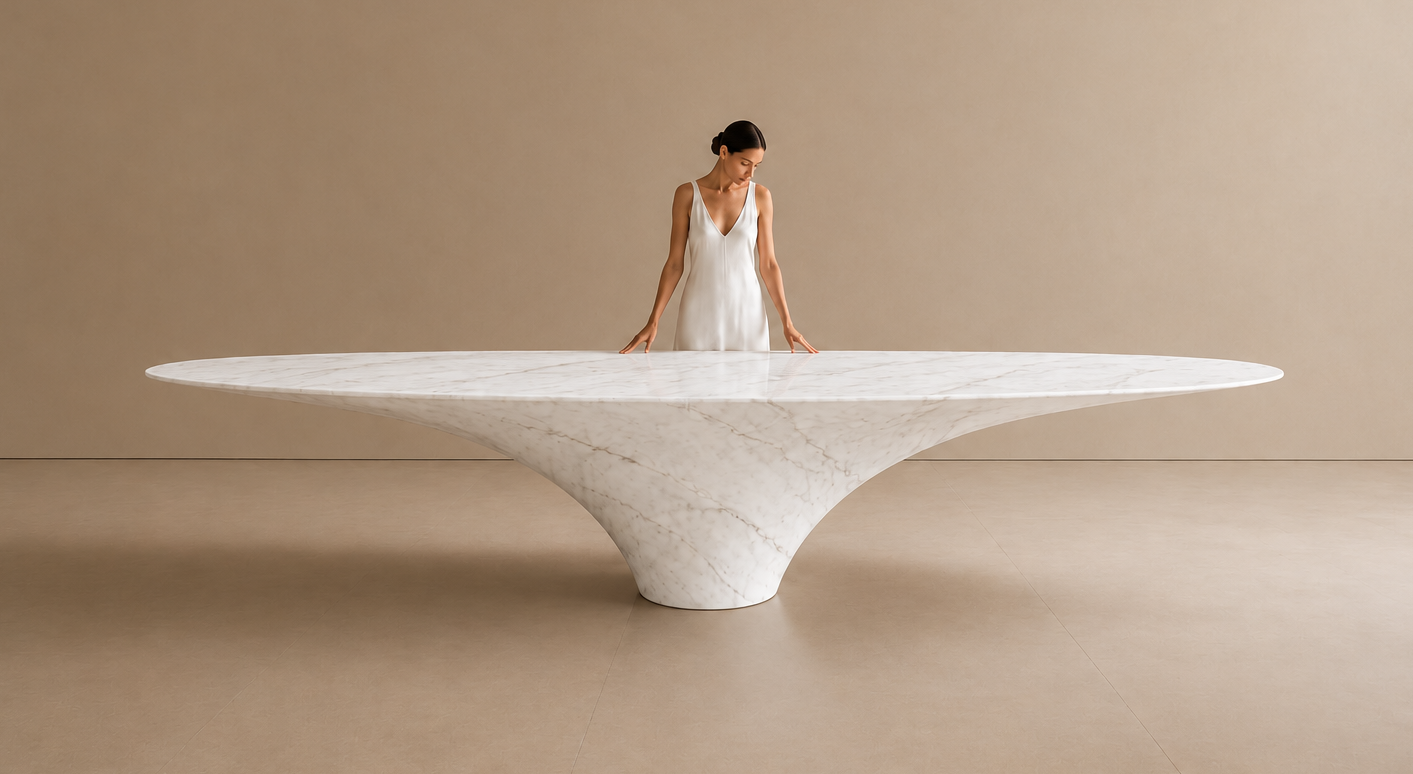
When I create a bench or a table, I approach it first as a sculpture. Its functional purpose introduces another dimension into the creative process, but it does not determine the artistic language.
Naturally, there are additional considerations: ergonomics, structural strength, stability and the way the body interacts with the piece.
What interests me is that functionality can create a beautiful intimacy between the person and the sculpture.
We usually observe a sculpture, move around it or experience its presence. With sculptural furniture we can also touch it, sit on it and connect physically with its form.
Both belong to the same artistic universe. They are different ways of establishing a relationship between matter, space and human experience.
ARTCOLLECTORNEWS: Movement is a recurring element in your work, even when the sculpture itself is entirely still. Your earlier compositions explored the relationship between two separate forms, whereas more recent pieces increasingly suggest unity and continuity. How has your understanding of duality changed, and what can sculpture express about relationships between seemingly opposing forces?
Duality has been one of the central themes of my work.
I have always been fascinated by apparent opposites: light and darkness, movement and stillness, masculine and feminine, matter and void.
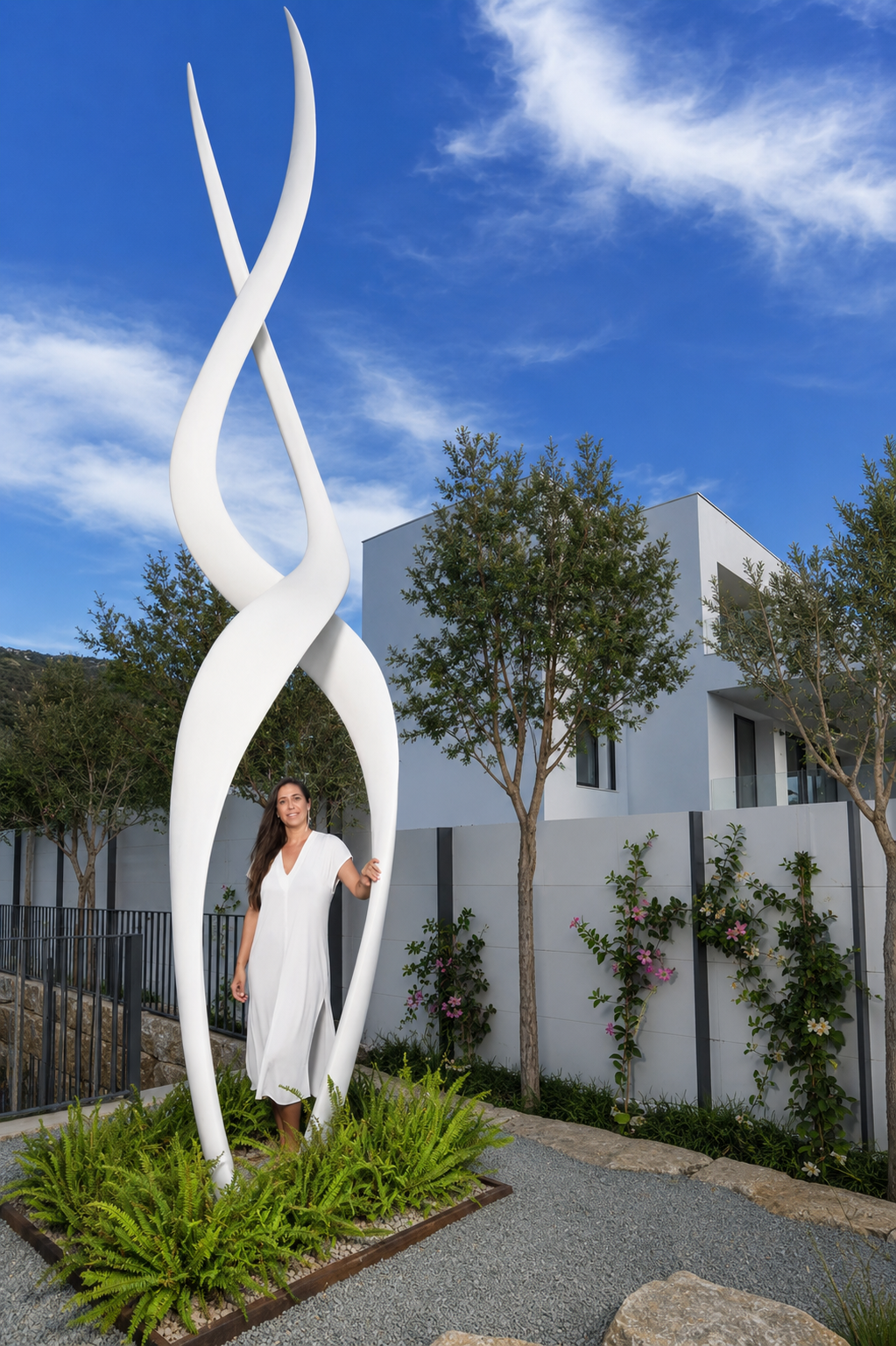
In my first sculptures, from 2014, these relationships were often expressed through two lines dancing with each other, capturing moments and forms of that constant balance.
Over time, my understanding evolved. I began drawing the Japanese ensō as a form of meditation, and this drew me ever closer to the circle, to the infinite line that returns upon itself, and to continuous forms.
The circle is especially meaningful because it has no beginning and no end. It allows me to express unity without denying the existence of duality. Movement remains essential, but it is no longer merely a physical suggestion. It becomes a movement of perception, guiding the eye and inviting the mind to follow a continuous path.
I am interested in that instant when two seemingly opposing forces stop competing and become part of a single whole. For me, that is fullness, wisdom — that which holds everything in harmony.

ARTCOLLECTORNEWS: You were awarded the 2025 Ciudad de Badajoz Sculpture Prize for Unity Enzo. What does that particular work represent within your artistic development? Did creating it resolve something you had been investigating for years, or did it open up an entirely new direction?
UNITY ENZO marks a particularly important moment in my artistic evolution, because it brings together many of the ideas I had been exploring for years.
Its form is reduced to a single continuous sculptural gesture. There is no unnecessary element, and yet it contains movement, tension, balance and a profound sense of unity. It is unity born of duality.
For me, it also represents the shift from a sculptural form that rises upwards to a more expansive one.
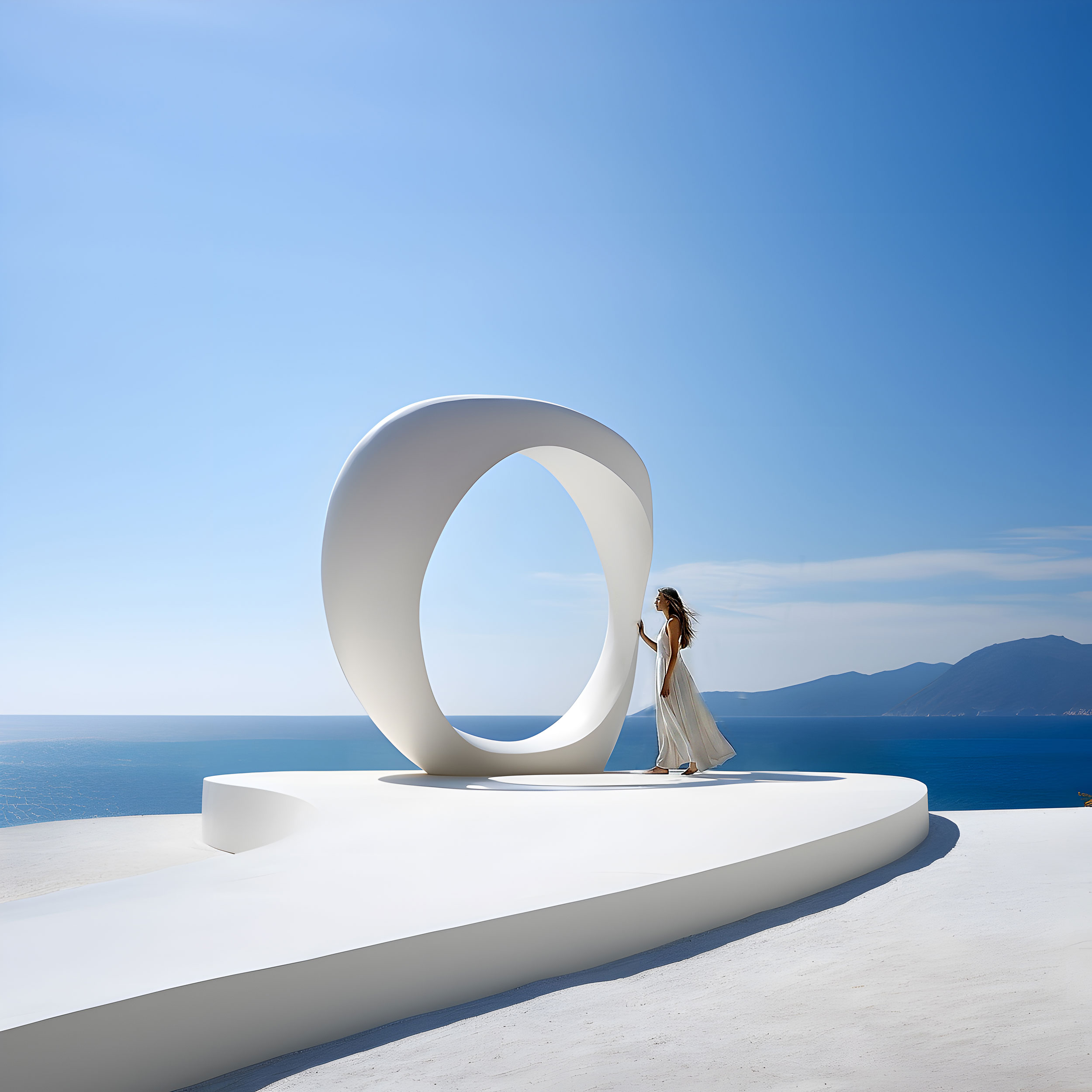
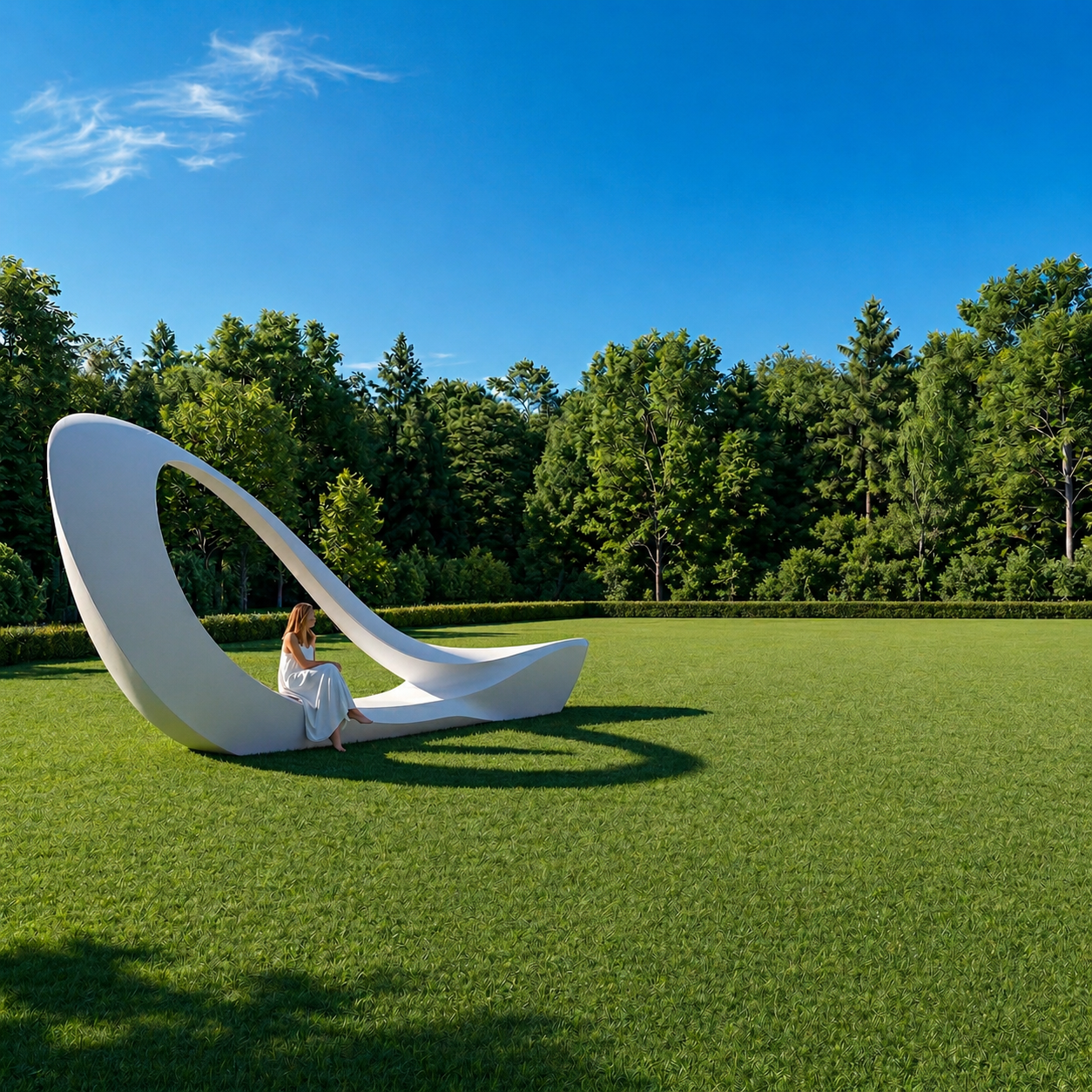
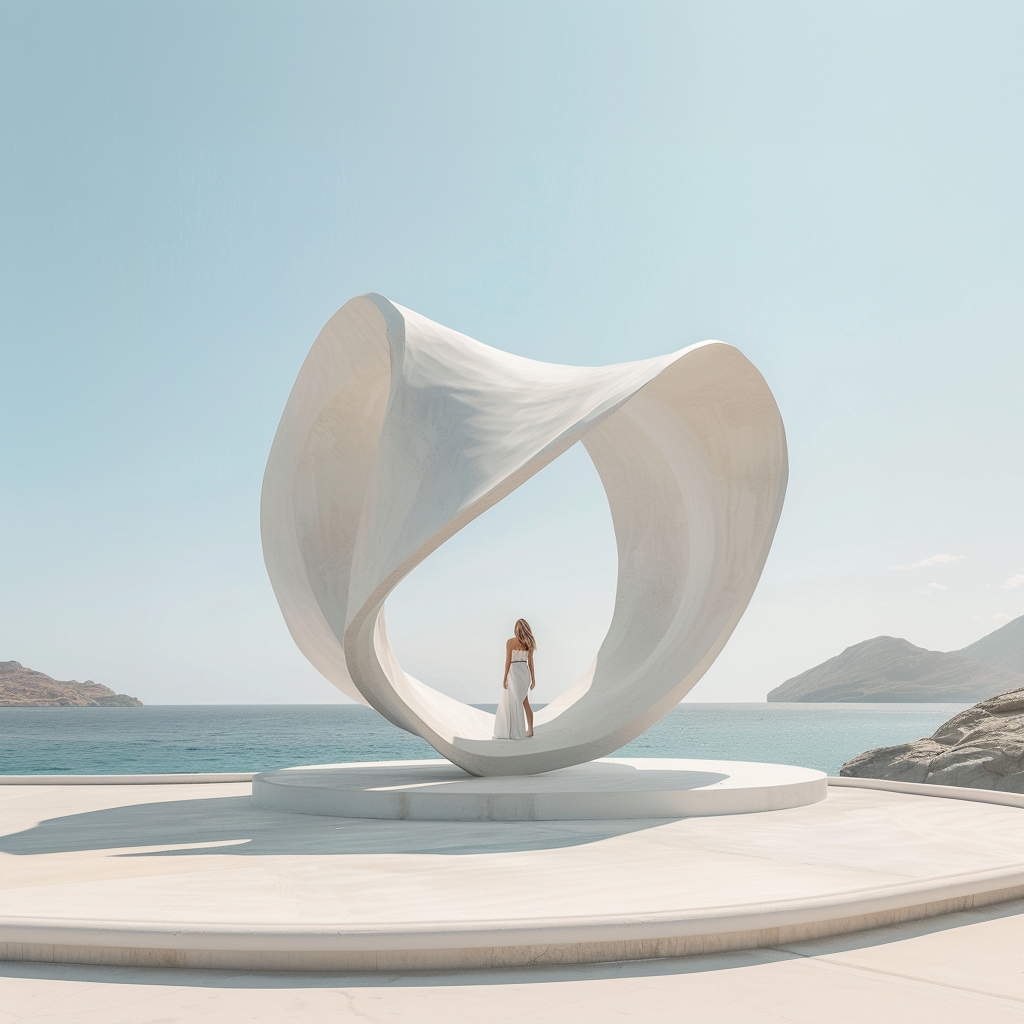
The central opening carries as much meaning as the matter surrounding it. The sculpture no longer exists solely as an object: it establishes a relationship with what lies beyond and becomes an energetic portal.
Receiving the City of Badajoz Sculpture Prize in 2025 was especially meaningful because it recognised this more circular, expansive and autonomous direction in my work.
It has led me to create works on a larger scale, such as a five-metre monumental sculpture that will be installed in Paris in January 2027.
Sacred Geometry, Spirituality and the Invisible
ARTCOLLECTORNEWS: Sacred geometry has become fundamental to your artistic philosophy. For someone encountering your work for the first time, how would you explain its significance beyond visual harmony? Can you take us through a particular sculpture and describe how specific proportions or geometric relationships informed its creation?
For me, sacred geometry is far more than a system of beautiful proportions. It is a way of studying the underlying order of nature and the relationship between form, space and human energetic perception.
Throughout history, geometry has played a fundamental role in architecture, from ancient temples to the cathedrals and sacred buildings of different civilisations.
These structures were not conceived according to aesthetic criteria alone. Proportion, orientation, rhythm and spatial relationships often carried mathematical, symbolic and spiritual meaning.
I am particularly interested in how these principles can be translated into contemporary sculpture.
I work with geometric constructions and relationships, including those associated with the golden ratio, to explore how different proportions shape the character of a form. For monumental sculptures I work with the latitude of the site: from that number, all the other dimensions are generated, the height, the length of the line, the base. Each measurement emits a different energy.
Every place has its own sacred measurements, and by using them you can create that harmony and change how a person feels on entering a space or seeing the piece.
For smaller pieces, or works created before I know where they will be installed, I usually generate them from the sacred geometry of my birthplace, Granada, in Spain. At times I have taken the latitude of places of power, such as Jerusalem, Chartres or the pyramids of Egypt. The energy of that place can be transmitted through those specific dimensions.
These decisions may be subtle, but they are fundamental to the energy of the work.

ARTCOLLECTORNEWS: You have spoken about the influence of sacred architecture and the relationship between proportion and human experience. Growing up in Granada, with the Alhambra among your early architectural references, did you develop this sensitivity to space instinctively, or was it something you consciously studied later? Are there particular buildings or places that have profoundly influenced how you understand sculpture today?
Growing up in Granada profoundly shaped my sensitivity to architecture and space.
The Alhambra was part of my visual and cultural world long before I understood the mathematics, symbolism or geobiology of its architecture.
What fascinates me about the Alhambra is the extraordinary relationship between geometry, light, water, matter and human scale.
Its architecture creates experiences through proportion and rhythm, but also through silence, shadow and the spaces between its structural elements.
Later, through my studies and my growing interest in sacred geometry, I began to understand these experiences from another perspective.
I was fascinated by the geometric systems used in ancient architecture and by the idea that buildings could be conceived not only as physical structures, but as environments for contemplation and spiritual experience — spaces where you can go to heal, to recharge, to bring out the best in yourself.
Gaudí's architecture has also been important to me, especially his ability to translate the structural intelligence of nature into architectural language. I loved seeing and touching the railings of La Pedrera and its furniture. Art Nouveau was also one of the key references in the creation of my work.
And I feel a deep connection with spaces where light, matter and void enter into silent dialogue. The work of Campo Baeza, Peter Zumthor, James Turrell and Richard Serra has also been key in shaping a body of work that aspires to be timeless.
These influences have taught me that the most powerful architectural experiences do not always arise from what we see, but from what a space allows us to experience.
ARTCOLLECTORNEWS: Your more recent work engages with the Ensō, the circular symbol associated with Zen Buddhism. What first attracted you to this form? How did your interpretation develop from the idea of a unified circle towards the open, inhabitable threshold of your portal sculptures? What does the Japanese tradition contribute to your understanding of the form?
I have always been drawn to the circle for its simplicity and universality.
It appears in nature and across cultures as a symbol of continuity, unity and infinity.
Discovering the ensō added another dimension to this fascination.
In Zen Buddhism, the ensō is traditionally drawn as a spontaneous gesture, often in a single stroke. It can express ideas of enlightenment, wisdom, fullness, freedom, emptiness…
What resonates with me most is the idea that a simple form can hold something infinitely complex.
In my work, the circle gradually evolved from a symbolic representation of unity into a physical threshold — an energetic portal.
Through the portal sculptures, I began exploring what happens when viewers can look through a form, walk around it or even pass through it.
The circle is no longer just something to contemplate. It becomes an invitation to experience space differently.
I deeply value the Japanese sensitivity to emptiness, restraint and the expressive power of a single gesture.
My interpretation, however, is personal. It brings those philosophical references together with my research into sacred geometry, energy, movement and the relationship between matter and space.

ARTCOLLECTORNEWS: In works such as ENSO GATE, the empty space at the centre is as important as the sculptural structure surrounding it. How do you approach the relationship between material and void? Can absence itself become the most expressive element of a sculpture?
Absolutely. In fact, I increasingly feel that the void is the true protagonist of many of my sculptures.
In traditional sculpture we tend to focus on matter: its volume, surface, texture and physical presence.
My recent work invites us to consider what is not materially present.
The void is not simply an absence. It lets light through, frames the landscape, connects different spaces and changes continually with the viewer's position.
In an energetic portal sculpture, matter defines the threshold, but the experience takes place through the opening.
I am fascinated by this apparent paradox: we use matter to give presence to the void.
There is a beautiful connection here with Taoist philosophy, particularly the idea that the usefulness of a vessel lies in the empty space within it.
For me, this is also a metaphor for life. We often focus on what is visible and tangible, overlooking the importance of what exists between things.
Sometimes the most essential part of a sculpture is precisely what has been left open.
ARTCOLLECTORNEWS: Alongside sacred geometry, your practice incorporates ideas from Feng Shui, Vastu Shastra and energetic space harmonisation. These traditions emerge from distinct philosophical and cultural histories. How do you bring them into your artistic process? Are there practical decisions concerning orientation, dimensions, material or placement that might be invisible to the viewer but essential to the finished work?
I approach these traditions with deep respect for their different cultural origins, while recognising that they share an interest in the relationship between human beings and the spaces they inhabit.
Studying Feng Shui, Vastu Shastra and geobiology has broadened my understanding of sculpture and architecture — above all, it has shown me the similarities and coincidences in how all ancestral cultures built.
For me, creating a work is not only about defining its form. It also means considering how it relates to its surroundings and what it awakens in the person who sees and feels it.
Depending on the project, I may study orientation, natural light, circulation, proportions and the relationship between the sculpture and its surroundings.
I am also interested in traditional geometric systems and the symbolic qualities associated with particular proportions and directions.
In a site-specific commission, these considerations can influence the dimensions, placement and orientation of the sculpture.
Some decisions are immediately visible. Others remain hidden within the creative process.
My intention is to bring together artistic intuition, geometric understanding and sensitivity to the atmosphere of a place.
I understand energetic harmonisation as part of my personal artistic and spiritual practice.

ARTCOLLECTORNEWS: You describe your creations as Totems of Light, intended to introduce harmony, balance and a particular energetic quality into their surroundings. These ideas are deeply personal and not necessarily experienced in the same way by every viewer. How do you understand the relationship between your intention as an artist and another person's experience of the work? Does someone need to share your spiritual perspective to engage fully with your sculptures?
I believe art should remain open to individual interpretation.
When I describe my sculptures as Totems of Light, I am expressing an intention that is part of my creative process.
For me, light is both a physical and a symbolic presence. It represents consciousness, openness, transformation and the possibility of seeing beyond appearances.
I work with these ideas through form, proportion, matter and space. I don't expect the viewer to understand or share every aspect of my philosophy — but they will inevitably feel it.
One person may experience the sculpture simply as a beautiful form. Another may feel calm, curiosity or connection. Someone else may discover something entirely different.
I believe the most meaningful works of art allow each person to establish their own relationship with them.
My role as an artist is to create the conditions for that encounter, not to dictate what someone should feel.
If a sculpture invites us to pause, observe and become more aware of the space around us, I already consider that a beautiful beginning.
ARTCOLLECTORNEWS: There is a fascinating history of artists attempting to express intangible dimensions of existence through abstraction, from Hilma af Klint and Kandinsky to later sculptors concerned with perception, contemplation and space. Do you feel an affinity with any particular artists or artistic traditions, either historically or today? Where do you see your own approach differing from theirs?
I feel a particularly strong connection with artists who have explored dimensions of reality that are not immediately visible.
Hilma af Klint is especially meaningful to me because she understood abstraction as a language through which to explore spiritual and universal principles. I admire the courage and independence of her research, above all given the era in which she lived.
My relationship with spirituality is different, but I recognise a shared desire to give form to the intangible.
I have also been deeply influenced by Constantin Brancusi and his pursuit of essence through the simplification of form.
Richard Serra has been important in understanding how sculpture can transform our physical experience of space, while Anish Kapoor's exploration of void, matter and perception has opened fascinating possibilities.
James Turrell and Olafur Eliasson have also influenced the way I think about light and the experience of an environment.
What perhaps distinguishes my approach is the combination of these concerns with sacred geometry and my practice of spatial harmonisation.
I am interested not only in how a sculpture looks or how we perceive it, but also in the relationship it establishes with the place it inhabits.
My work arises from a desire to unite artistic expression, the intelligence of natural forms and a personal understanding of energy and space.

Matter, Craft and the Creative Process
ARTCOLLECTORNEWS: Your sculptures often appear remarkably light and fluid, even when constructed from materials as substantial as marble, bronze or steel. How do you reconcile the physical weight of these materials with your desire to create a sense of movement or immateriality? Is there a material that has fundamentally changed the way you think about form?
I love working with materials that seem to contradict the forms I create.
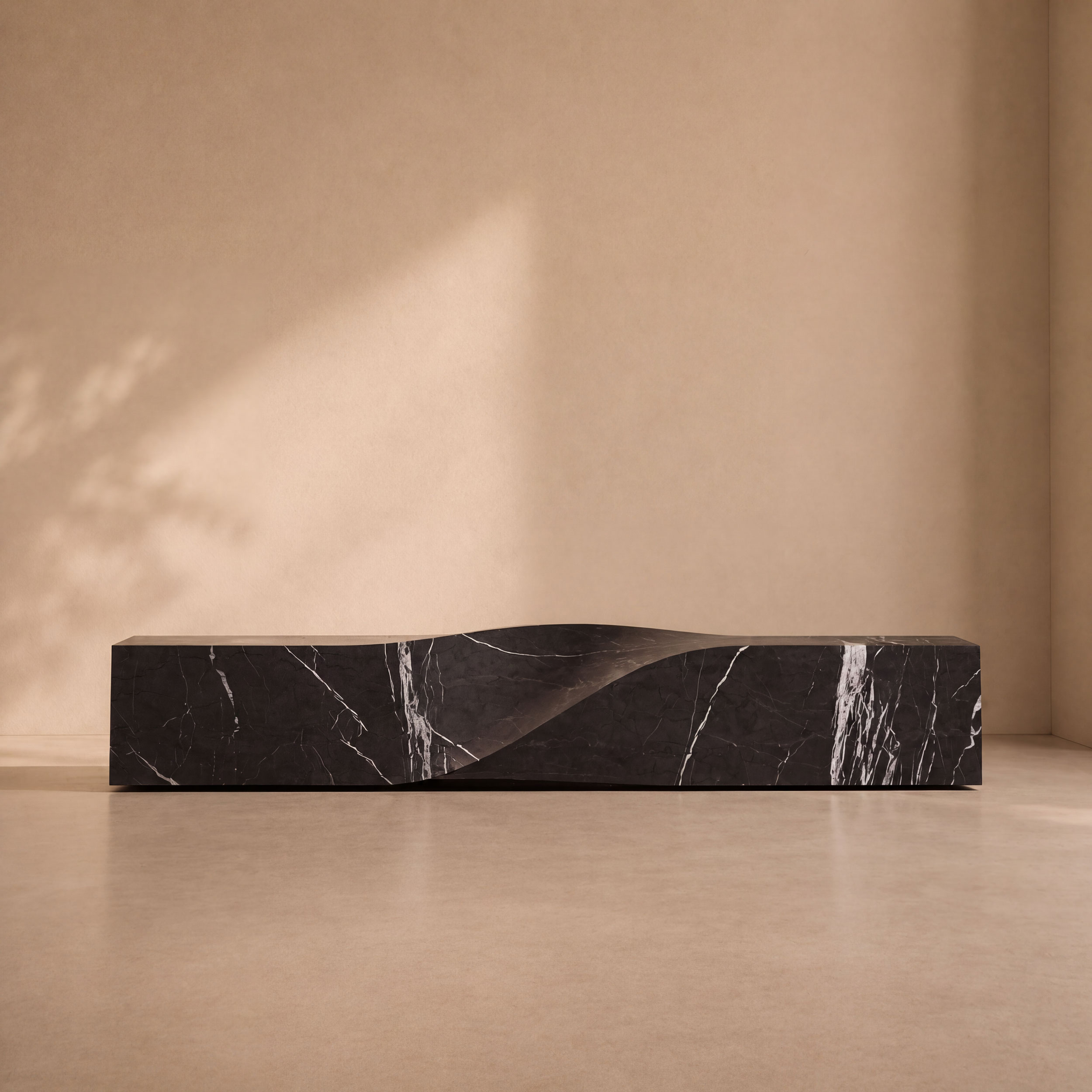
There is something fascinating about transforming a heavy block of marble into a sculpture that appears to twist effortlessly, or giving steel the appearance of a fluid gesture.
For me, that tension between physical weight and visual lightness is part of the poetry of sculpture.
I don't try to deny the nature of the material. I want to reveal possibilities we might not expect to find in it.
Wood taught me a great deal about organic movement and continuity, because its grain holds the story of its natural growth.
Marble introduced another relationship with time, permanence and precision. It demands a particular sensitivity, because every decision is irreversible.
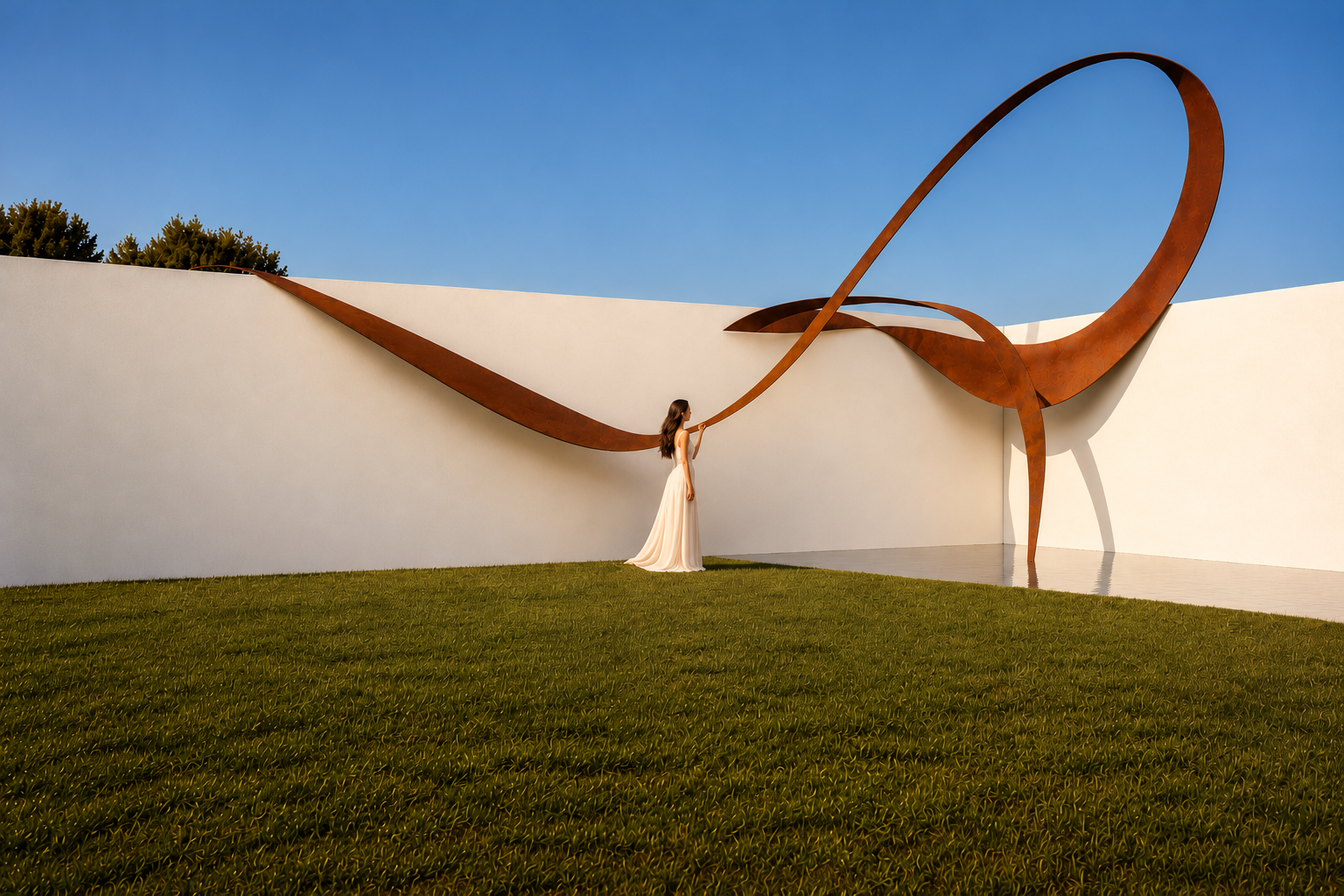
Steel has given me the freedom to explore ever more monumental forms, in which mass, balance and void can coexist on an architectural scale.
Each material has expanded my artistic language.
What interests me most is the moment when physical substance seems to transcend its own limitations. Each material also brings its own intrinsic energy. Marble, for instance, never ceases to amaze me: every texture, vein and colour has been forming over millions of years.
ARTCOLLECTORNEWS: You work closely with highly specialised artisans, including stoneworkers, metalworkers and woodcarvers. Your 2025 New York exhibition at Ateliers Courbet also introduced works developed through collaborations with craftspeople in the Italian Dolomites. How does an idea evolve from your initial drawings or models into a finished sculpture? At what point does the craftsperson's knowledge begin to influence the artistic outcome?
My creative process usually begins with an intuition, a movement or a geometric relationship I want to explore.
I develop the idea through drawings, studies and three-dimensional computer models until the form begins to express what I am searching for.
At that point, the dialogue with materials and craftsmanship becomes essential.
I have immense respect for the artisans I work with. Their knowledge of wood, stone, metal and traditional techniques comes from years — sometimes generations — of experience.
They bring a knowledge that cannot be replaced by technology or theory alone.
Working with specialist artisans in the Italian Dolomites, for example, has allowed me to explore the possibilities and limits of wood, and with artisans in Almería, in Spain, the excellence of stone, in ways that enrich the creative process.
The artistic vision and the formal language remain mine, but making a sculpture is a continuous dialogue: they are the experts in each material. I learn how far I can go with each of them by visiting and being with them throughout the production of every piece.
Sometimes a technical challenge reveals an unexpected possibility. At other times, the material itself suggests a refinement.
I believe this exchange is fundamental.
A sculpture is not simply an idea translated into matter. It is an encounter between artistic vision, material intelligence and human knowledge.

ARTCOLLECTORNEWS: The transformation of natural materials has its own history and poetry. A piece of timber carries the story of its growth, while marble reveals geological time, and Cor-ten steel continues to change with exposure to the elements. To what extent do you allow these intrinsic material qualities to guide your work, rather than trying to impose a predetermined form upon them?
I believe every material has its own memory.
When I work with wood from centuries-old trees, I am aware that the material has lived a whole history long before becoming part of my work.
Its grain, density, colour and knots tell the story of its growth.
Stone holds another notion of time. Marble has formed through geological processes lasting millions of years, and its veins reveal movements and transformations that are almost impossible for us to comprehend.
Corten steel is especially interesting because it keeps evolving. Its surface responds to atmospheric conditions and develops a patina that becomes part of the sculpture's life.
I try to respect these qualities rather than erase them.
Of course, I start from a clear artistic intention, but I believe the material must be allowed to take part in the process.
Sometimes its natural characteristics become an essential part of the composition. In other cases, as with my Soul Sculpture, the design varies depending on whether it is made in corten steel, solid wood or marble, yet it keeps the same essence.
There is something profoundly beautiful about creating contemporary forms from materials that hold such different expressions of time.
In a sense, I am giving new form to something that already has a history and an energy of its own.
ARTCOLLECTORNEWS: You have used the language of simplicity and essence to describe your practice, yet arriving at a simple form can involve enormous technical complexity. How do you know when a sculpture is finished? Is there a point at which removing anything further would diminish rather than strengthen the work?
Simplicity and essential form are among the hardest things to achieve.
A complex form can contain many elements that attract our attention, but once you begin removing them, every remaining line becomes fundamental.
There is nowhere left to hide.
My creative process often involves eliminating everything that does not contribute to the movement or essential meaning of the sculpture.
I work until I reach a point where the relationships between form, proportion, mass and void feel complete.
There is an intuitive moment when I recognise that the work has found its balance.
Removing anything more would weaken that relationship.
I admire Brancusi's understanding of simplicity as the result of profound distillation, not as an absence of complexity.
For me, a sculpture is finished when it needs nothing added and nothing can be taken away without losing its essence.

Monumental Sculpture and the Architecture of Space
ARTCOLLECTORNEWS: Your presentation of ENSO GATE at The Art Square in Brussels marked an important development in your public sculptural practice. What was it like to encounter the work at an architectural scale and in an environment beyond the gallery? Did seeing people approach and move around it change your perception of the sculpture itself?
Presenting ENSO GATE in Brussels was an important moment because it allowed the sculpture to enter into dialogue with a broader architectural and public setting. The piece was originally intended to be five metres high, but we ultimately chose to reduce its scale.
In an exhibition space, the environment is relatively controlled. In a public place, the work becomes part of everyday life.
The light changes throughout the day, people approach from different directions and the surrounding architecture becomes part of the composition.
What particularly interests me is how each person discovers the work through movement, air and weather.
From one angle, the sculpture may appear as a strong, almost graphic form. From another, its opening frames an entirely different perspective.
The relationship between the body, the sculpture and the surrounding space becomes far more evident.
For me, this reinforces the idea that monumental sculpture is not simply a larger object.
It is an experience that unfolds through the viewer's presence and movement.
ARTCOLLECTORNEWS: Monumental sculpture introduces considerations that rarely arise in smaller works: structural engineering, environmental conditions, public interaction, long-term conservation and the relationship with existing architecture. How have these practical demands influenced your creative process? Has increasing the scale of your work also changed its conceptual possibilities?
Working at monumental scale has introduced an entirely new level of complexity into my practice.
A sculptural gesture that looks simple in a small model can become an extraordinary engineering challenge when translated into several metres of steel or another massive material.
Structural stability, foundations, wind loads, fabrication processes, transport and installation all become fundamental considerations.
This requires close collaboration with highly specialised engineers, architects and fabricators.
I find the process fascinating because it brings artistic intuition into dialogue with technical precision.
But the most important transformation is conceptual.
At monumental scale, sculpture establishes a direct relationship with the human body and the surrounding architecture.
The viewer no longer experiences it only from the outside. The work can create a threshold, define a space or alter our perception of a landscape.
This opens possibilities that simply don't exist at a smaller scale. There are sculptures that overwhelm through their sheer size.
I am increasingly interested in sculpture as an architectural presence, capable of creating meaningful places.

ARTCOLLECTORNEWS: Your studio has outlined forthcoming monumental projects for Paris, alongside a significant commission for a private residence in La Moraleja, Madrid. What can you share about these developments? How do you approach the distinction between creating a sculpture for an intimate architectural setting and producing something intended to become part of a larger public or urban landscape?
I am currently developing several monumental projects, including two five-metre sculptures for an architectural development in Paris.
These works continue my exploration of unity, movement and the relationship between matter and empty space.
I am particularly interested in their permanent integration into an environment where people will encounter them as part of their daily lives. Each piece becomes an emblem.
In Madrid, I am also working on a monumental commission — a sculpture four metres in height and diameter — for a private residential setting, where the relationship between sculpture, architecture and landscape becomes more intimate.
The approach to each project is quite different.
In a private residence, I can explore a more personal dialogue with the architecture, the proportions of the space and the way its inhabitants experience it over time. This piece is made in mirror-polished stainless steel.
In a public setting, the sculpture must respond to a far wider range of perspectives and interactions. The two Paris sculptures, each five metres high, are in corten steel, and their finish will continue to transform day by day.
My underlying intention remains the same: to create a sculptural presence that belongs to its surroundings and establishes a meaningful relationship with those who experience it — to create energetic portals that harmonise the place.
ARTCOLLECTORNEWS: You have spoken about wanting sculpture to contribute to the experience of a place. If you were given complete freedom to create a monumental work anywhere in the world, what kind of environment would you choose? Would you be drawn towards a natural landscape, a historic architectural setting or an entirely contemporary public space?
I think I would choose a place where nature and architecture could enter into meaningful dialogue.
Perhaps a wide, open landscape facing the sea, where the horizon became part of the sculpture.
The sea has always been especially important to me. Its movement, its reflections and its constant transformation are closely tied to my understanding of life and form.
I imagine a monumental sculpture creating a threshold between land, sea and sky.
A place where the work does not compete with its surroundings, but helps us become more aware of them.
I would love to see how the sculpture changes throughout the day, how shadows move across the ground and how the landscape is framed by its openings.
Ideally, it would be a place where people naturally slow down.
I don't dream of creating a monument simply to be seen from afar.
I would love to create an inhabitable space — a place of contemplation, silence and connection.

Collecting and Living with Art
ARTCOLLECTORNEWS: Many of our readers are collectors who live with sculpture and collectible design every day. What do you believe a three-dimensional artwork can contribute to a home that a painting or photograph cannot? When visiting a collector's residence for the first time, what do you observe before deciding where a sculpture might belong?
Sculpture has an especially intimate relationship with architecture because it shares the same physical space as we do.
A painting creates a visual experience within a defined surface. A sculpture establishes a three-dimensional presence that changes with our position, the movement of light and the surrounding architecture.
We experience it with our whole body.
When I visit a residence for the first time, I pay attention to far more than the dimensions of the rooms.
I observe the natural light, the architectural proportions, the circulation between spaces and the relationship between inside and outside.
I also want to understand how the people who live there experience their home.
A sculpture should never feel like an object that has simply been placed in an empty corner.
I want it to establish a natural dialogue with its surroundings.
Sometimes the most powerful location is not the most obvious one. It might be a transitional space, a quiet vista or a place where the light changes throughout the day.
For me, living with art means developing a relationship with something that continues to reveal itself over time — and with sculpture that relationship is even closer, because the person can feel it, touch it and become part of the work.
ARTCOLLECTORNEWS: Your practice encompasses unique sculptures, commissioned works and collectible design pieces. How do you approach the balance between an artist's creative independence and a collector's personal vision? What should collectors understand about authorship, editions, materials and long-term care when acquiring one of your works?
I see a commission as a dialogue between the collector's vision, the architectural context and my own artistic language.
Understanding the person who will live with the work is important, especially when creating a unique sculpture for a specific setting.
But I also believe artistic independence is essential.
A meaningful commission should not simply reproduce the client's expectations. It must bring something unexpected — something that can only emerge from the artist's vision.
When collectors acquire my work, I want them to understand both its conceptual origins and the extraordinary craftsmanship involved in its creation.
Authorship, provenance and the distinction between unique works and limited editions are fundamental.
Every work is signed and accompanied by the corresponding documentation, including edition details where applicable.
Materials are equally important. Natural stone, solid wood, bronze and corten steel each have distinct characteristics, and their surfaces may evolve over time.
Understanding those qualities is part of understanding the work itself, as is following the appropriate conservation guidance.
Ultimately, I hope collectors will see these pieces not simply as acquisitions, but as works of art that will form a lasting relationship with their lives and their spaces.

The Search for Essence
ARTCOLLECTORNEWS: Looking ahead, your work seems to be moving beyond the sculptural object towards a more immersive relationship with architecture, landscape and human experience. After nearly twenty years of artistic exploration, what remains unresolved for you? Is there an idea, experience or quality of space that you have not yet found a way to express through sculpture?
I feel I am only beginning to understand the possibilities of what I am searching for.
For almost twenty years I have explored the relationship between nature, essential form, movement and balance, grounded in sacred measurements.
Today I am increasingly interested in what happens when sculpture becomes more than an object — when it transforms into an environment or an experience.
I would love to explore creating spaces conceived entirely through geometric proportion, light, matter and the relationship between the human body and architecture.
Places where sculpture and architecture become inseparable.
My interest in sacred geometry and energetic harmonisation keeps opening new questions about how we perceive and inhabit our surroundings.
I don't think I will ever reach a definitive answer, and perhaps that is the most beautiful part of being an artist.
Every work reveals something, but it also leads to a new question.
If the first part of my career was about giving form to nature, and the second about discovering its essence, perhaps the next will be about allowing that essence to become a space we can enter and experience — a place to rest and be at peace.
I am increasingly interested in what sculpture makes possible.
Kandinsky at $60–80m, Lichtenstein at $20–30m, Kusama, Nara, Bacon, Hopper and Agnes Gund: the November lots that matter beyond the headline estimates.
Art Week Tokyo meets Mariko Mori’s landmark retrospective, while SCAI, KOTARO NUKAGA, Taka Ishii, Pace and KOSAKU KANECHIKA sharpen the gallery route.