The Whitney’s first Lichtenstein retrospective in New York in more than thirty years reunites his landmark 1962 Castelli debut and follows the artist across six decades. For collectors, it is a timely chance to look beyond the market’s early-Pop hierarchy and reconsider the full intelligence of the oeuvre.
Roy Lichtenstein: Why the First New York Retrospective in More Than 30 Years Matters to Collectors
The Whitney’s first Lichtenstein retrospective in New York in more than thirty years reunites his landmark 1962 Castelli debut and follows the artist across six decades. For collectors, it is a timely chance to look beyond the market’s early-Pop hierarchy and reconsider the full intelligence of the oeuvre.

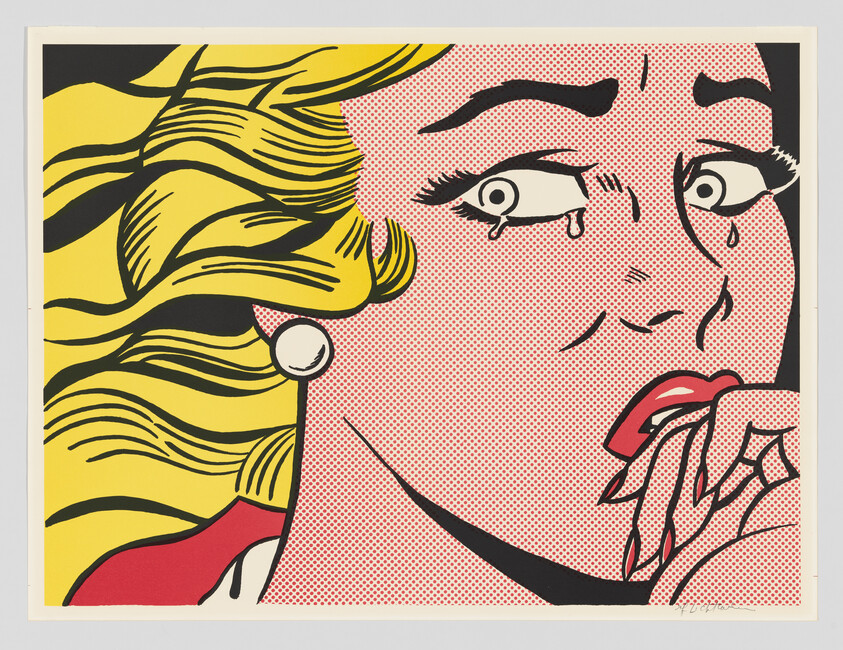
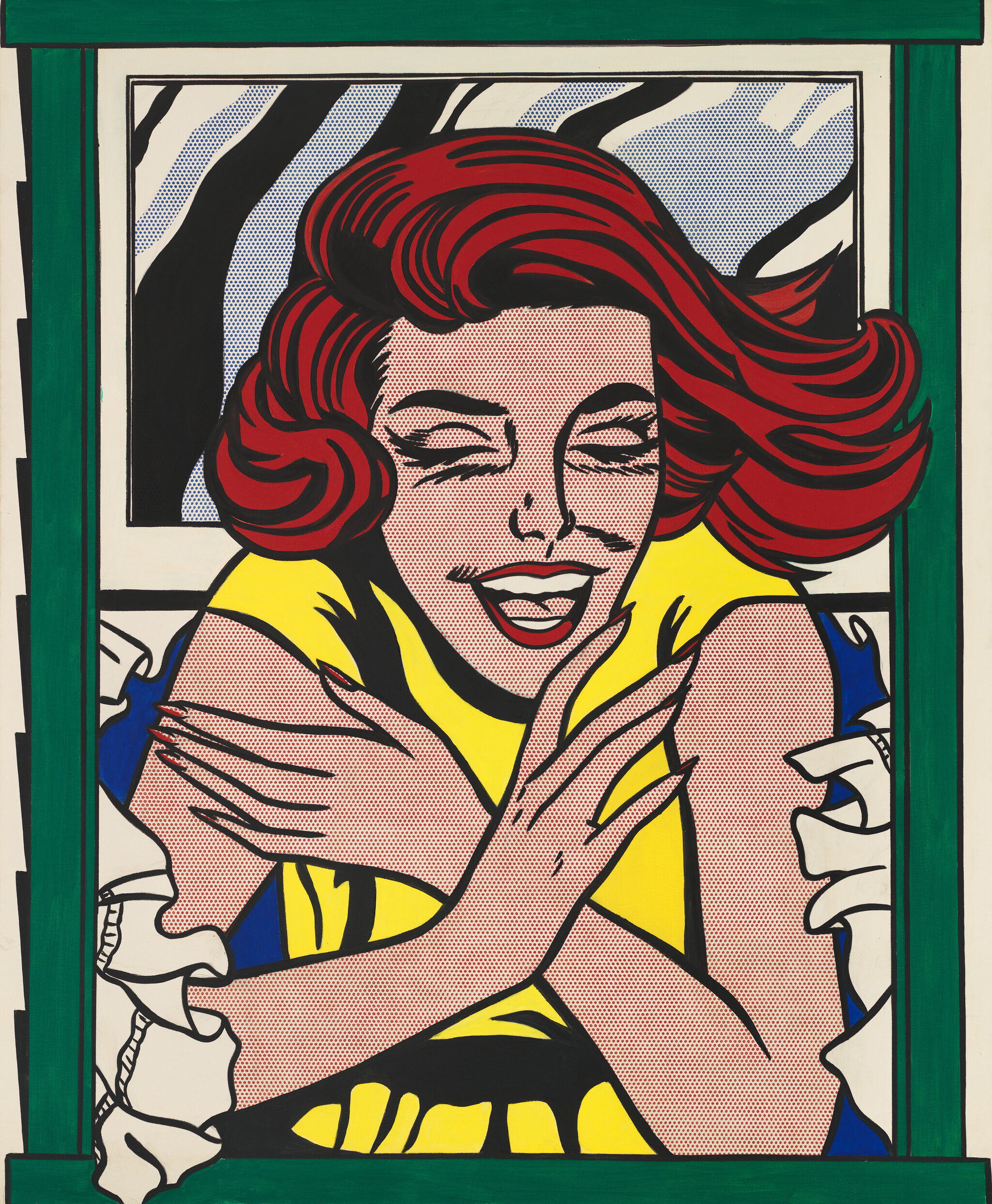
Roy Lichtenstein is one of those artists whose success can get in the way of seeing him. The dots, speech balloons, hard black contours and emotionally charged comic-book faces are so completely absorbed into visual culture that the work risks becoming shorthand for Pop itself. Recognition arrives before looking does.
That is why Roy Lichtenstein: Like New, opening at the Whitney Museum of American Art on 11 October 2026, matters. The exhibition brings together more than 130 works spanning six decades, from the early 1940s through the 1990s, and is the first Lichtenstein retrospective in New York in more than thirty years. Rather than treating the artist as the inventor of a handful of famous motifs, the Whitney is asking a broader question: what happens when we understand Lichtenstein as an artist of images — their circulation, repetition, instability and afterlife?
For collectors, that shift is particularly useful. Lichtenstein’s market has long been dominated by a small group of early-1960s paintings, especially the comic-derived women and war pictures that established his reputation. Yet the Whitney’s chronology makes clear that the breakthrough was the beginning of an investigation, not its conclusion. Across painting, drawing, printmaking, sculpture, film, murals, interiors and the late experiments of the 1990s, Lichtenstein kept asking what an image becomes when it is copied, translated and made to perform again.

The 1962 Castelli show, reunited
The exhibition’s most important historical gesture is the reunion of all eight works from Lichtenstein’s landmark 1962 debut of Pop-style paintings at Leo Castelli Gallery. The Whitney is reconstructing the intimate gallery setting so that the group can be encountered together for the first time since the moment that effectively announced a new pictorial language.
Today, it is difficult to recover the risk of those paintings because their descendants are everywhere. In 1962, however, the move was confrontational. Abstract Expressionism had made the unique gesture and the psychology of the artist central to post-war American painting. Lichtenstein responded with pictures that appeared cool, anonymous and mechanically reproduced. Commercial printing, advertisements and comics entered the space of fine art without apologising for their origins.
The apparent impersonality was deceptive. Lichtenstein did not simply enlarge comic panels. His process involved selection, drawing, projection, redrawing, simplification and painstaking adjustment. The Ben-Day dots that read as mechanical from a distance were the product of controlled studio labour. The paintings were not copies in the passive sense; they were transformations whose meaning depended on the gap between source and result.
That distinction has become even more relevant in 2026. We now encounter images through reposts, screenshots, crops, filters, compression and algorithmic circulation. The question at the centre of Lichtenstein’s work — what changes when an image is detached from one context and rebuilt inside another? — no longer belongs only to Pop art history. It describes ordinary visual life.

The brushstroke after the heroic brushstroke
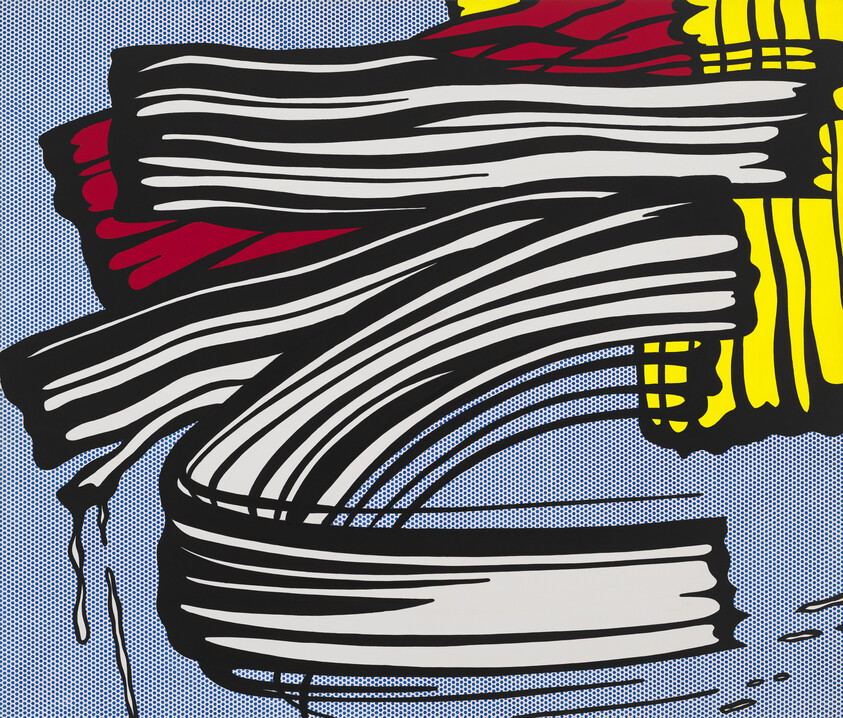
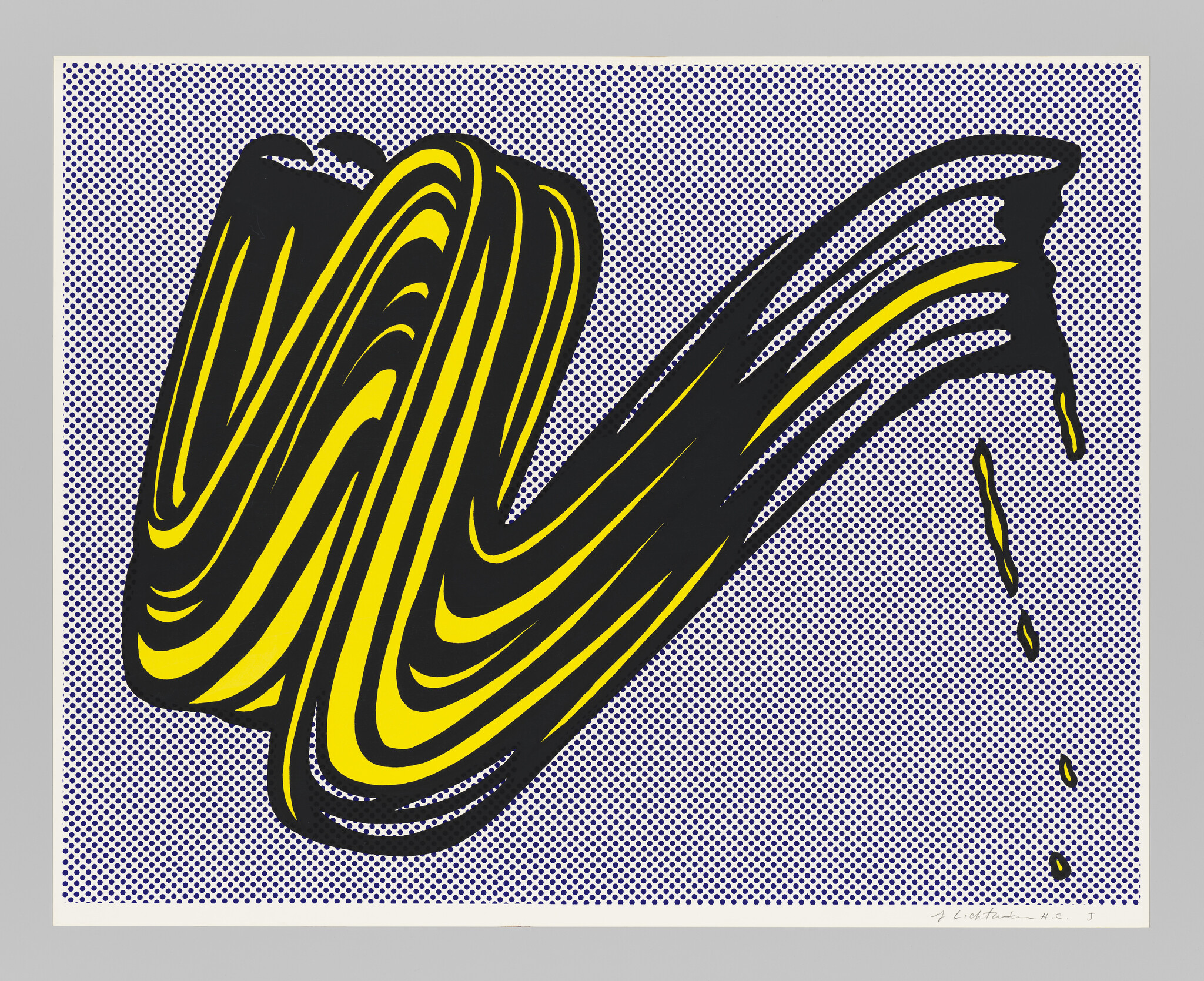
Little Big Painting and the Brushstroke works demonstrate why reducing Lichtenstein to comics misses so much. Here the source is not popular illustration but modern art itself. The spontaneous, heroic gesture associated with Abstract Expressionism is turned into an image of a gesture: enlarged, outlined, flattened and disciplined by dots.
The joke is sharp, but it is not merely dismissive. Lichtenstein could parody the mythology of expressive painting while constructing powerful abstract compositions of his own. The brushstroke becomes something like a logo for painting — a sign that says “gesture” while refusing to behave gesturally.
For collectors, this is a useful reminder that the strongest bodies of work often contain internal arguments. Lichtenstein did not move from commercial imagery to art history because he had exhausted Pop. He recognised that art history itself was another image bank. Monet, Picasso, Matisse, Cubism, the studio, the still life and the brushstroke could all be circulated, quoted and transformed just as a comic panel could.
Why the market hierarchy is narrower than the oeuvre
Lichtenstein’s market remains formidable, but it is also highly selective. Christie’s sale of Nurse in 2015 for $95.365 million remains the artist’s auction record. In 2017, Agnes Gund’s Masterpiece was reported to have sold privately for $165 million, with proceeds helping to launch the Art for Justice Fund. More recently, Anxious Girl, painted in 1964 and unseen publicly for decades, sold at Christie’s New York in May 2026 for $46.06 million.
Those numbers clarify what the market rewards most aggressively: scarce, immediately recognisable paintings from the early Pop breakthrough, particularly tightly cropped female subjects from the 1963–65 period. That hierarchy is understandable. The images are historically important, visually definitive and exceptionally difficult to secure.
But a mature collector should distinguish between the top of a price hierarchy and the full significance of an artist’s practice. A museum survey can be especially valuable when it expands the map. It allows later interiors, mirrors, landscapes, still lifes, prints, sculptural experiments and preparatory works to be seen not as secondary categories but as parts of a sustained inquiry.

Still life, art history and the problem of familiarity
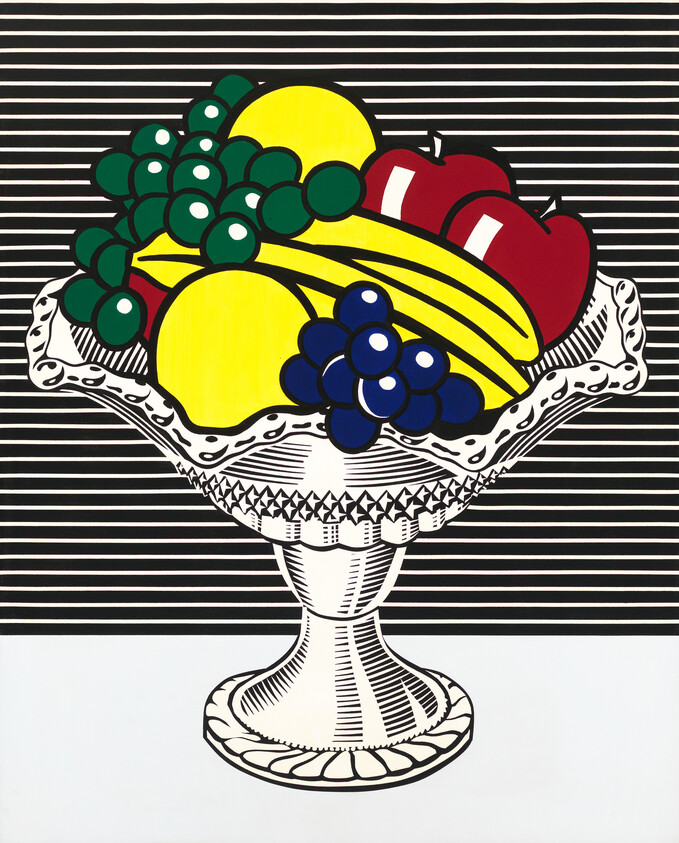
Still Life with Crystal Bowl is a good example of the way Lichtenstein’s later work complicates the easy version of Pop. The subject belongs to one of the oldest traditions in Western painting, yet it is translated through stripes, flat colour, hard edges and graphic shorthand. The object is recognisable instantly, but the painting keeps calling attention to the conventions that make recognition possible.
This is one of Lichtenstein’s recurring achievements: he makes style visible as a system. A fruit bowl, a cathedral façade or a studio interior becomes a test case for how a visual language tells us what we are seeing. The subject and the mechanism of depiction remain present at the same time.
That is also why the Whitney’s inclusion of Rouen Cathedral, Set III is important. Monet’s serial paintings explored how the same motif changed under different conditions of light. Lichtenstein translates that legacy into the language of reproduction. The subject is no longer simply the cathedral; it is the history of looking at the cathedral through another artist, another style and another technology of images.
More than paintings: prints, sculpture, interiors and murals
Like New is strongest conceptually when the practice expands beyond the canonical canvases. The exhibition includes drawing, collage, prints, sculpture and film, as well as recreated murals. Among them is a nearly 96-foot iteration of the Greene Street Mural of 1983. Scale is critical here. Lichtenstein reproductions can look almost frictionless in books and on screens; large murals restore the bodily relation between viewer and image.
Printmaking deserves similar attention. For Lichtenstein, editions were not peripheral merchandise around the paintings. Mechanical reproduction was one of the central subjects of the art, which made print a particularly charged medium. Collectors entering the market through works on paper should therefore ask not only about rarity and signature but about how a particular print relates to the artist’s larger investigation of repetition, reversal and commercial image-making.
That does not mean all editions are equal. Condition, colour stability, paper, printing history, publisher, edition size and provenance matter enormously. But the medium itself should not be treated as intellectually subordinate simply because its price structure differs from unique paintings.

The late work deserves another look
The Whitney is reinforcing the retrospective with a second, focused exhibition: Roy Lichtenstein: 1997, now on view on the museum’s third floor. It brings together rarely seen works from the final year of the artist’s life, including prints, photographs, sculptural maquettes, drawings and collage studies for projects that were never realised.
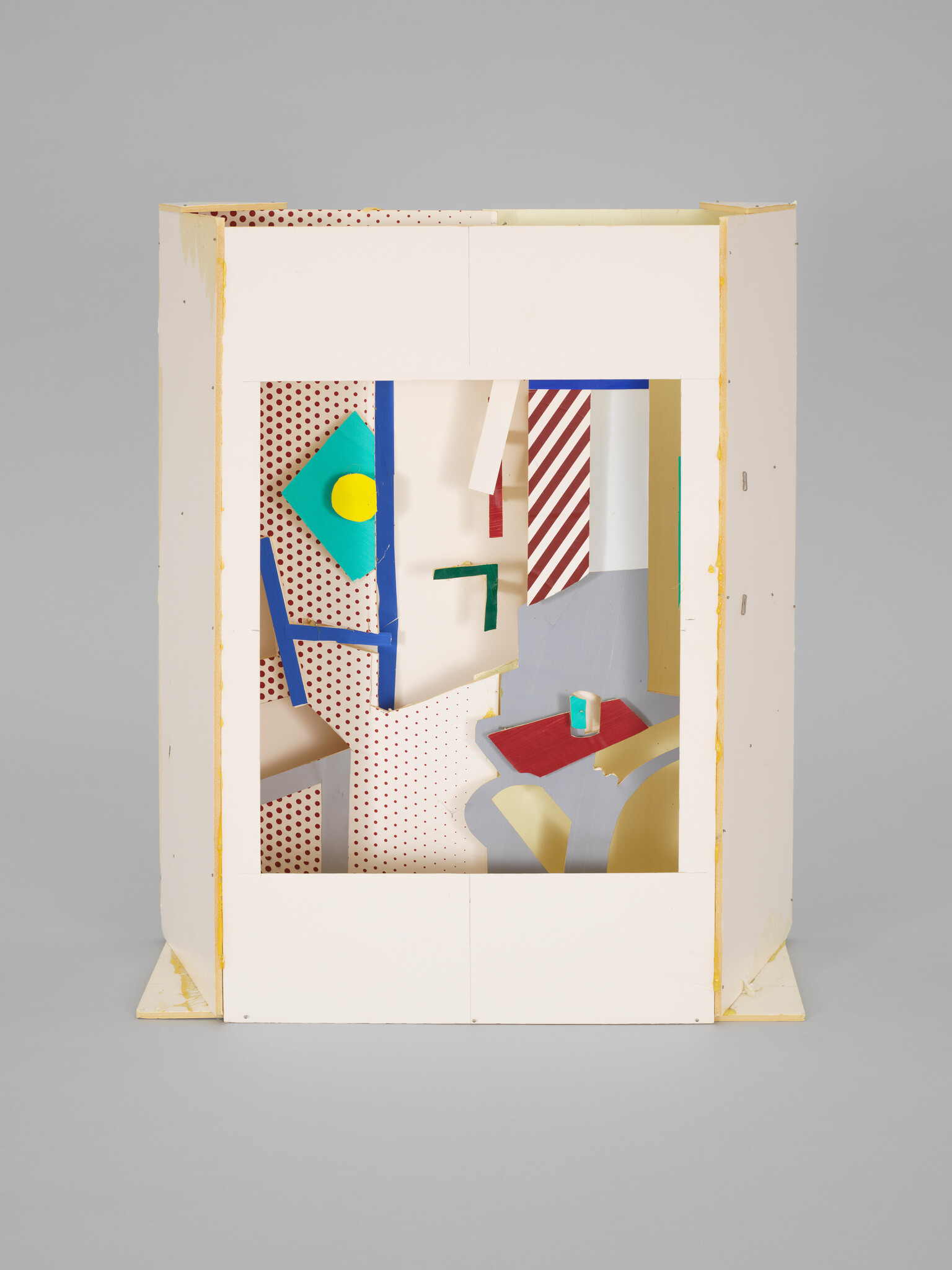
The timing is intelligent because it prevents the retrospective from ending where the market most often does. Lichtenstein continued to experiment into the 1990s, responding to interiors, digital image culture, three-dimensional models and new forms of pictorial simulation. Works such as the Hologram Interior models make the point particularly clearly: an artist associated with the flat, graphic surface was still thinking spatially and materially at the end of his career.
For collectors, late work can be one of the most revealing parts of a retrospective because it tests whether an artist remained inventive after the signature style had become secure. Lichtenstein did. The visual vocabulary is recognisable, but the problems keep changing.
Appropriation looks different after the internet
No serious reconsideration of Lichtenstein can avoid the question of source material. His use of comics and commercial imagery has long generated debate about authorship, credit and transformation. The Whitney’s decision to include artists such as Louise Lawler, Richard Pettibone and Sturtevant is useful because it places Lichtenstein inside a larger history of appropriation rather than treating borrowing as an isolated quirk of Pop.
The ethical and art-historical questions should not be flattened into a simple defence or prosecution. What matters is understanding exactly what Lichtenstein changed: scale, cropping, colour, drawing, composition, medium, context and cultural status. The resulting works became new objects with new audiences and new economic lives, while still depending on pre-existing images.
That tension feels especially contemporary. Image culture today is built on circulation and reuse, but also on increasingly urgent questions about authorship and consent. Lichtenstein does not provide a comfortable answer. He provides a historically important case in which copying itself becomes visible as a creative and cultural act.

What collectors should take from Like New
The collector lesson is not that overlooked Lichtenstein categories will suddenly catch up with the prices of the great 1960s paintings. Markets do not become democratic because museums become comprehensive. The lesson is more useful than that.
First, understand period and image hierarchy without allowing them to substitute for quality. The early comic paintings are scarce for good reason, but a strong work from another body of work may communicate more of Lichtenstein’s thinking than a weak example bought simply because it contains a familiar motif.
Second, distinguish medium from importance. Prints, drawings, studies and sculptural models can illuminate the mechanics of the practice in ways a finished painting cannot. For collectors at different price levels, they can offer intellectually serious routes into the oeuvre — provided condition, provenance and edition details are handled carefully.
Third, look for relationships. Lichtenstein’s career becomes richer when Brushstroke, Rouen Cathedral, the studio interiors, murals and late models are understood alongside the comic-derived icons. The artist’s subject was never merely mass culture. It was the behaviour of images themselves.
An artist made familiar enough to become strange again
The best retrospectives do not simply confirm reputation. They disturb it. Like New has the potential to do that precisely because Lichtenstein’s reputation appears so settled. He is canonical, instantly recognisable and deeply embedded in both museum history and the market. Those are advantages, but they can also harden an artist into a logo.
The Whitney’s argument is that there is more instability beneath the clean surface than familiarity suggests. The dots imitate printing but are bound to the hand. The borrowed image becomes an original object. The heroic brushstroke becomes a controlled sign. Art history becomes source material. A domestic interior becomes a model for virtual space. Repetition keeps generating difference.
For collectors, that is the reason to see the exhibition whole. The most expensive Lichtensteins may remain the great early Pop icons. But the most interesting collection of Lichtenstein need not be organised around price rank alone. Like New offers a broader proposition: collect the intelligence of the practice, not merely its most famous face.
Roy Lichtenstein: Like New opens at the Whitney Museum of American Art, New York, on 11 October 2026 and runs through 10 May 2027. Member previews take place 8–10 October. Roy Lichtenstein: 1997 is already on view at the Whitney and runs through 1 June 2027.
With a new Boesky exhibition and their first mid-career museum survey arriving almost in tandem, the Haas Brothers reveal the systems, material intelligence and serious sculptural ambition beneath their famous exuberance.
Our collector’s edit of London Design Festival 2026 prioritises sculptural furniture, studio glass, design history and emerging makers — the work most likely to matter after festival week ends.