LATEST NEWS:
Jenny Holzer & Andy Goldsworthy win 2026 Praemium Imperiale • €9m Renoir museum heist in France • Dimitris Daskalopoulos donates 51 works to museums in Greece & Scotland • Artist Lucien Smith dies aged 37 • Faro Santander opens with 1,000-work collection • Argentina orders return of Nazi-looted Old Master • Greece rejects Parthenon Marbles loan request • Smithsonian chief Lonnie Bunch announces retirement
Go Back
Magazine

George Lucas, Mellody Hobson and the Museum Built Around a Collector’s Question: What Counts as Art?

Opening 22 September, the Lucas Museum of Narrative Art turns George Lucas and Mellody Hobson’s cross-category collecting philosophy into a major public institution.

Exhibitions
Exhibitions
George Lucas, Mellody Hobson and the Museum Built Around a Collector’s Question: What Counts as Art?

When the Lucas Museum of Narrative Art opens in Los Angeles on 22 September, its most provocative act may be curatorial rather than architectural. George Lucas and Mellody Hobson have built an institution around a collector’s question museums have often avoided: why should illustration, comics and cinema be treated as culturally secondary to painting?

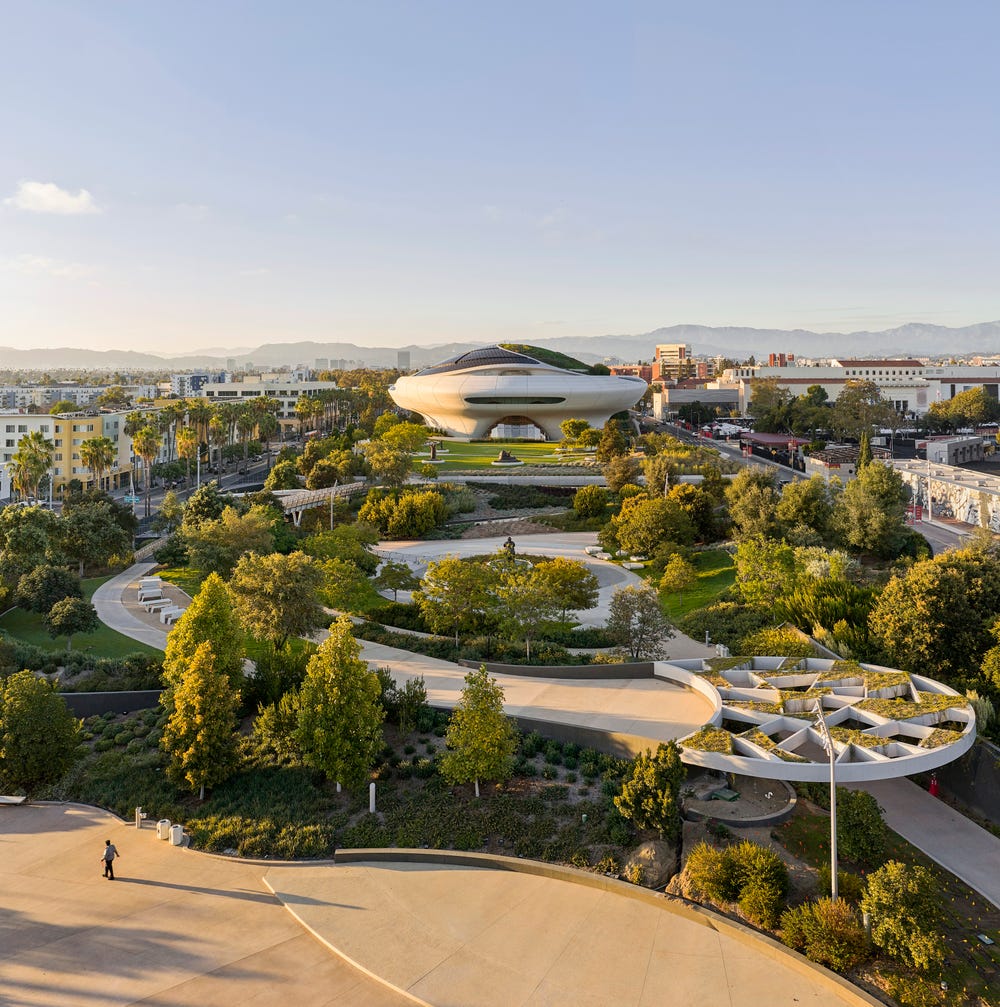
The Lucas Museum of Narrative Art arrives with the scale of a major civic institution: a new building in Exposition Park designed by Ma Yansong of MAD with Stantec, more than 100,000 square feet of exhibition space across over 30 galleries, a research library, film theatres, a restaurant and a 13-acre public landscape by Mia Lehrer and Studio-MLA.

Yet the physical scale is not the most interesting part. The museum is the institutional form of George Lucas and Mellody Hobson’s collecting philosophy. Their collection refuses a hierarchy that places “fine art” safely above illustration, comics, production design or cinematic image-making. Norman Rockwell, N. C. Wyeth and Robert Crumb can share the same museum logic as Frida Kahlo, Jacob Lawrence, Charles White, Robert Colescott, Judith F. Baca and Diego Rivera.

For collectors, that is consequential. Private collecting has always been able to cross categories more freely than museums. The Lucas Museum asks what happens when that private freedom becomes a public institution.

A college purchase becomes a museum

The museum traces Lucas’s collecting impulse back to college, when he bought an illustration of Alley Oop, the time-travelling comic-strip caveman. It is an unusually humble origin story for an institution of this scale, and a useful one. The collection did not begin with an attempt to construct a canon. It began with attraction to an image and the story it carried.

N C Wyeth The Storybook Lucas Museum collection
N. C. Wyeth, The Storybook, cover for Ladies’ Home Journal, 1921–22. Illustration is placed on equal institutional footing with fine art, comics and cinema. Image courtesy Lucas Museum of Narrative Art.

N. C. Wyeth’s The Storybook, created as a Ladies’ Home Journal cover in 1921–22, illustrates the museum’s challenge to conventional category. Commercial illustration has often been admired while remaining institutionally separate from “major” art. At Lucas, narrative function is not a disqualification. It is the organising principle.

This has the potential to change how visitors see familiar images. An illustration can be considered through composition, material, authorship and historical context without pretending it was made for the same purpose as an easel painting. Equality does not require sameness.

The collection is built around use, not medium

The museum defines narrative art through what images do: communicate stories, beliefs, myths and social values. That allows a cave painting, a comic page, a mural and a film-production drawing to enter the same conversation.

The inaugural exhibitions spread more than 1,300 works through 100,000 square feet. The first-floor historical presentation reaches across tens of thousands of years, while upper galleries explore themes, media and individual artists. The museum is also using high-resolution reproductions and 3D scans when immovable works or sites cannot physically travel.

That approach will be debated, as it should be. Reproduction is not the same as object encounter. But the underlying question is valuable: is the museum’s first responsibility to preserve hierarchies of medium, or to build intelligible relationships between images?

The Lucas Museum turns a collector’s refusal to respect category boundaries into an institutional proposition.

What counts as a serious collection?

The answer matters to collectors because the market still assigns prestige unevenly. Illustration, comics and production art can have sophisticated specialist markets while remaining peripheral in traditional art-history narratives. The Lucas collection treats those fields as central records of how modern culture imagines itself.

This is particularly clear in the Lucas Archives, which contain materials retained from Lucasfilm productions spanning 1971 to 2012. Props, costumes, drawings and film-related artefacts are not presented as celebrity memorabilia alone. They are part of the visual process through which stories were invented and circulated globally.

Collectors working in any non-traditional field should recognise the pattern. Institutional validation often follows private conviction, not the other way around. Photography, design, fashion, self-taught art and digital media have all moved through versions of this process.

A library beside the spectacle

One of the most important elements may be less photogenic than the building: the research library.

Lucas Museum free research library
The museum’s research library opens with the institution on 22 September and is intended as a free scholarly resource. Courtesy Lucas Museum of Narrative Art; architecture/campus photography by Hufton+Crow

A serious museum needs scholarship capable of testing the claims its collection makes. The library signals that narrative art is intended to become a research field rather than simply a visitor-friendly theme. For collectors, this distinction is critical. Passion creates collections; scholarship makes them durable.

The strongest private collections eventually generate archives, catalogues, provenance records and intellectual context. When those materials are neglected, the collection’s knowledge can disappear even if the objects survive.

The building performs the same argument

Ma Yansong’s architecture avoids the conventional image of the museum as a stone or glass box. The building is low, fluid and almost topographic, merging with a landscaped campus rather than presenting itself as a sealed monument.

Lucas Museum 13 acre park and gardens Exposition Park
Mia Lehrer/Studio-MLA designed the museum’s 13-acre park and gardens, replacing a former asphalt parking lot with public landscape. Courtesy Lucas Museum of Narrative Art; architecture/campus photography by Hufton+Crow

The surrounding 13 acres matter in Los Angeles. Studio-MLA’s landscape replaces what had been asphalt parking with more than 300 newly planted trees, drought-tolerant and indigenous planting, a hanging garden, amphitheater, meadow and water feature. The museum is therefore not only a repository for a private collection made public; it is a new piece of urban public space in South Los Angeles.

This is an important part of patronage at scale. A collector-founded museum can be criticised, fairly, for the degree to which one private taste becomes public culture. The best response is not to deny that authorship but to make the institution useful beyond the collection itself.

Film does not enter through a side door

The museum’s theatres and continuous screenings reinforce the refusal to quarantine cinema as entertainment adjacent to art.

Lucas Museum theater cinema space
Film is treated as part of the museum’s narrative-art continuum, supported by the Lucas Archives and continuous screenings. Courtesy Lucas Museum of Narrative Art; architecture/campus photography by Hufton+Crow

That matters because film is one of the dominant image-making forms of the last century, yet museum structures have often struggled with its duration, reproduction and mass audience. Lucas’s own career makes the emphasis inevitable, but the broader curatorial proposition is stronger than biography: popular images deserve serious visual analysis because popularity is itself a form of cultural power.

What collectors should watch after opening

The museum will be judged on whether its category-breaking thesis produces illuminating juxtapositions or merely an enormous range of material. Scale can help and hurt. More than 30 galleries allow depth, but a universal history of storytelling can become so broad that differences between objects disappear.

The most interesting test will be specificity. Can the museum teach visitors why a Rockwell painting works as painting and illustration, why a comic page structures time differently from a canvas, why production art matters independently of the finished film, and why a Kahlo or Colescott belongs in the same institution without being flattened into “storytelling” as a generic theme?

If it succeeds, the Lucas Museum could offer collectors a powerful permission: a collection does not have to inherit the museum’s old departmental boundaries. It can begin from an intellectual question and let the objects follow.

Collector note: build the thesis before the building

The Lucas Museum is an extreme example of a principle available to collections of any size: articulate the question the collection is trying to answer. Lucas and Hobson can move from Wyeth to Crumb to Kahlo because the organising thesis is visual storytelling rather than a medium, nationality or decade. That does not make every acquisition automatically coherent, but it gives each purchase something to test against.

Private collectors rarely need a mission statement, yet a simple internal question can prevent incoherent accumulation. What kinds of objects keep recurring? What historical problem are you repeatedly drawn to? Which categories have you excluded only because the market traditionally separates them? The answer can evolve, but writing it down creates a standard stronger than fashion. The Lucas Museum will now have to prove that its thesis works publicly. Collectors can learn from the experiment before ever considering a building of their own.

George Lucas’s first Alley Oop illustration could hardly have predicted a 300,000-square-foot museum. But that distance is the point. Collecting can begin almost anywhere. What matters is whether curiosity becomes knowledge, whether knowledge becomes coherence and whether a private obsession eventually creates value for people who were never part of the original purchase.

Date
Sep 10, 2026
Share

Latest Posts

September 10, 2026
Exhibitions
Exhibitions
George Lucas, Mellody Hobson and the Museum Built Around a Collector’s Question: What Counts as Art?

Opening 22 September, the Lucas Museum of Narrative Art turns George Lucas and Mellody Hobson’s cross-category collecting philosophy into a major public institution.
September 9, 2026
Articles
Articles
Park View: What a Four-Decade London Apartment Collection Teaches About Buying Across Categories

A four-decade London apartment collection coming to Dreweatts combines Regency furniture, antiquities, modern art and deep provenance into a masterclass in cross-category collecting.

September 9, 2026
Articles
Articles
The Great Art Inheritance Problem: What Happens When Your Children Don’t Want the Collection?

A lifetime collection can become an heir’s logistical, financial and emotional burden overnight. From changing taste and stale valuations to museum gifts, digital art and forced sales, what serious collectors should plan before the collection becomes an estate.