
October 18, 2026
Exhibitions
Exhibitions

From a £5 million Brueghel and three major Alice Neel sales to George Rickey, global modernism and a £675,000 Triceratops skull, Frieze Masters rewarded collectors who looked beyond categories.
From a £5 million Brueghel and three major Alice Neel sales to George Rickey, global modernism and a £675,000 Triceratops skull, Frieze Masters rewarded collectors who looked beyond categories.

Frieze Masters 2026 made its strongest case not through one record price or one spectacular object, but through the unlikely proximity of everything: a £5 million Jan Brueghel flower painting; Alice Neel portraits that made modernism feel socially unfinished; George Rickey moving almost imperceptibly beside Josef Albers; a mature Triceratops skull priced at £675,000; Egyptian sculpture, rare books and maps; and twentieth-century heavyweights from Picasso and Picabia to Warhol, Soulages, Ruscha, George Condo and Ai Weiwei.
That range could easily have become spectacle for spectacle’s sake. Instead, the 2026 edition was unusually coherent. More than 140 galleries occupied the Regent’s Park tent, but the fair felt more navigable than in some previous years, helped by presentations that increasingly behaved like exhibitions rather than inventories. Spotlight, Reflections and the new fair-wide thread Queering Modernism supplied intellectual structure, while the strongest dealers trusted individual works enough to give them space.
The market mood was similarly measured. The preview produced serious transactions and some emphatic seven-figure sales, but this was not indiscriminate buying. Collectors appeared willing to move quickly when quality, rarity, provenance and presentation aligned; elsewhere, reservations and extended conversations were as important as red dots. For a fair built around history, that slower form of conviction felt appropriate.
The headline sale belonged to Hauser & Wirth: Jan Brueghel the Elder’s Still Life of Flowers in a Stoneware Vase, painted around 1607–08, sold for around £5 million. It was a museum-grade object with a provenance that made the transaction more consequential than its price alone. Once owned by Baron Alphonse de Rothschild, the painting was seized by the Nazis in 1939, held for decades in Prague’s Národní Galerie and restituted in 2016. It later travelled on institutional loan in Canada before arriving at Masters.
Hauser & Wirth also reported Francis Picabia’s Untitled of around 1941–43 at €1.1 million and Picasso’s 1943 collage Violon at €850,000. Around them sat Hans Arp, Max Beckmann, Braque, Alberto Giacometti, Philip Guston, Marlow Moss, Gabriele Münter, Carol Rama, Lucian Freud and Oskar Schlemmer. The point was not simply blue-chip density. The stand’s most intelligent move was to show a new Flora Yukhnovich painting made in direct response to the Brueghel, allowing a contemporary artist to enter the historical argument without reducing the Old Master to a backdrop.
This was Masters at its best: historical importance did not require historical isolation.
David Zwirner and Victoria Miro’s joint Alice Neel presentation provided the fair’s most persuasive intersection of curatorial research and commercial demand. Three paintings sold for $1.8 million, $1.6 million and $1.6 million, but the presentation deserved attention before the prices were known.
Built around Neel’s portraits of queer sitters and their wider circle, it included works such as Allen Ginsberg (1966) and Kris Kirsten (1971), with archival material restoring social histories that can disappear when famous paintings circulate as isolated market objects. Neel’s loose brushwork and psychologically direct portraiture looked anything but safely canonical. Placed within Queering Modernism, it became clear again how much her paintings depend on the networks, friendships and communities around the people she painted.
The fact that these paintings also commanded some of the fair’s strongest reported prices is significant. Scholarship and market momentum are often discussed as opposites; this booth showed how effectively they can reinforce one another when the scholarship is real.
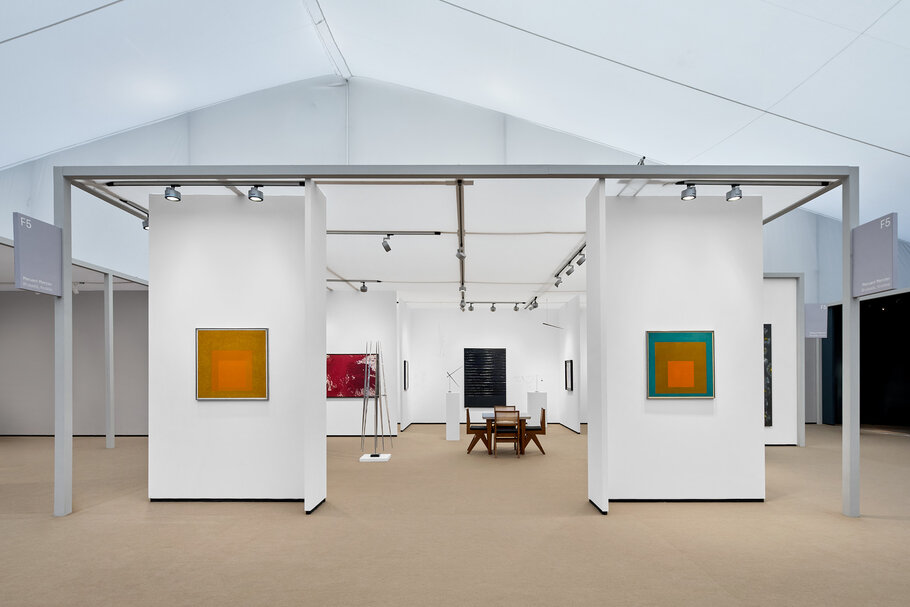
MARUANI MERCIER offered one of the most elegant booths in the fair. More than twenty works by George Rickey, spanning five decades, were placed in dialogue with early Josef Albers paintings and a formidable post-war group including Georg Baselitz, Ross Bleckner, Sam Francis, Peter Halley, Alex Katz, Robert Mangold, Louise Nevelson, Ed Ruscha, Pierre Soulages and Andy Warhol.
Rickey was the revelation. His kinetic sculptures are held in more than 180 museums, yet his name still occupies less space in many private collections than his institutional history would suggest. At Masters, works were priced from approximately £14,000 to £200,000, while an amber Albers nearby was offered at €1.5 million. That contrast was instructive: one artist carries textbook post-war market recognition; the other has museum authority that still exceeds his collector shorthand.
For collectors, that gap is precisely where Masters can be most useful. The fair is not only a place to confirm the value of known names; it can expose where art history and market familiarity remain out of sync.
Opposite the paintings, David Aaron supplied the fair’s most photographed collision of natural history and art-market theatre. A mature Triceratops skull carried an asking price of £675,000. Alongside it, a 145–155-million-year-old Camarasaurus supremus skull — remarkably, with an Allosaurus tooth still embedded in its lower jaw — was offered at £1 million. Both attracted interest from private collectors and institutions, though neither had been reported sold when the gallery was interviewed during the fair. A smaller sabre-cat skull, priced at £45,000, did find a buyer.
The temptation is to treat the dinosaur as a stunt. That misses what was interesting about the stand. Fossils now sit within a serious cross-category collecting culture alongside antiquities, design and fine art, and they demand their own due diligence: excavation and export history, scientific completeness, restoration, preparation and the distinction between genuine fossil material and reconstructed elements.
David Aaron’s actual sales reinforced that the stand was more than natural-history spectacle. Frieze reported the sale of an Egyptian wooden offering bearer listed at £285,000, a Cycladic marble head listed at £145,000, a Scythian gold stag plaque listed at £170,000 and the £45,000 sabre-cat skull. The gallery’s live fair inventory also marked a grouped pair of standing female idols, a Hebrew Masoretic text and a South Arabian alabaster head of a woman among additional sold objects.
Nearby, ArtAncient demonstrated the more classical side of that argument. Ancient objects can be visually immediate, but serious historical collecting requires a level of documentary attention that contemporary buyers sometimes underestimate. Ownership history, restoration and legal export are not accessories to the object. They are part of the object’s value.
One of the useful ambiguities of Frieze Masters is where “historical” ends. Vito Schnabel Gallery made the boundary almost meaningless, reporting George Condo’s Call Me Now (1988) at $925,000, Ai Weiwei’s Untitled (1983–85) at €450,000, Ron Gorchov’s Tarzan (1978) at $400,000, Markus Lüpertz’s Parsifal (Männer ohne Frauen) (1993) at €350,000 and René Ricard’s Spring Rain (1997) at $250,000. A work by Man Ray was also reported sold.
These are exactly the artists who reveal why Masters should not be treated as the older sibling one visits after the contemporary fair. Condo and Ai Weiwei remain active reference points in the contemporary market; Gorchov, Lüpertz and Ricard belong to histories that collectors are still actively repricing. Masters gave those works more breathing room than they might receive in a contemporary group booth.
Print specialists extended the same logic. David Hockney’s The Arrival of Spring, 29th of January, from an edition of 25, appeared at Archeus/Post-Modern alongside rarer Keith Haring material, while Shapero Modern showed Warhol portraits and a complete set of his cat prints. Waddington Custot reported strong interest around Chillida, Miró, Barry Flanagan, a 1958 Soulages and sculpture by Bernar Venet. Familiar names were everywhere, but the best presentations made specificity — series, date, proof, condition — matter more than celebrity.
The strongest counterweight to the established blue-chip market came through Spotlight and a growing number of galleries bringing modern and post-war histories from South Asia, North Africa, the Middle East and beyond. This was not diversity as decoration. It was visible in sales, museum interest and in the quality of the material.
Akar Prakar sold three of the six works it brought by the 90-year-old Indian painter Ganesh Haloi. Drawings were around £35,000 and larger paintings around £130,000, with buyers including Indian collectors and the Kiran Nadar Museum of Art. Akara Modern sold four works by Piraji Sagara from a presentation priced broadly between £40,000 and £250,000.
Loft Art Gallery sold Mohamed Melehi’s Untitled (1967) for €180,000 and had two further works reserved. Lawrie Shabibi sold two works on paper by the Palestinian-Persian artist Maliheh Afnan in the £30,000–£40,000 range, with a larger work reserved for a museum. These are not marginal transactions. They demonstrate an international market becoming more comfortable treating modernism as something that happened in many places at once.
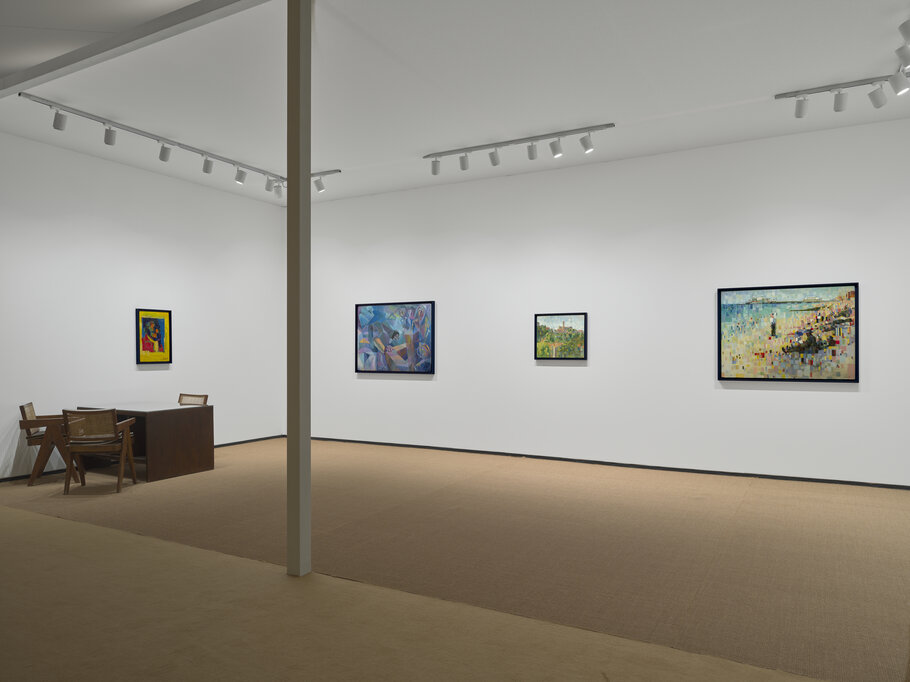
Vigo Gallery’s early Ibrahim El-Salahi paintings were especially good in this context. Made during his Slade years, before the visual language for which he became famous had fully formed, they showed an artist dismantling representation in real time. Works were priced from £145,000 to £400,000. For an artist who became the first African-born painter to receive a Tate Modern retrospective, these pictures were not a “discovery” so much as a newly visible chapter.
That distinction matters. The art market loves the word rediscovery. Masters was strongest when it replaced the cliché with actual research.

Daniel Crouch Rare Books offered one of the fair’s best changes of tempo. Maps, atlases and printed material require a different kind of looking from painting or sculpture. They make knowledge itself collectible: how geography was imagined, how power was represented, how travel and empire were made visible.
Elsewhere, the objects were unforgettable. Kunstkammer Georg Laue brought a rare South German drinking cup in the shape of a Gothic shoe, dated 1567; ArtAncient centred its pre-fair presentation on a monumental head of Sekhmet with an unusually well-documented twentieth-century provenance; specialists showed Tibetan painting, Iznik ceramics, Indian devotional work, Chinese silk and Picasso ceramics beside Roman, Greek and Egyptian sculpture.
That eclecticism is not a distraction from fine art. It is the intellectual premise of Masters. Great collections have rarely respected the category boundaries that fairs and auction departments impose on them.
The Frieze Tate Fund acquired Luis Fernando Zapata’s Barge (1992), a hand-moulded papier-mâché sculpture from the joint presentation by Galería Elvira Moreno and Alonso Garcés Galería. Zapata, a Colombian artist who spent significant periods in Paris, developed ritual objects around memory, loss, death and transformation against the background of the AIDS crisis.
The acquisition matters because it provides a counterpoint to the sales headlines. A £5 million Brueghel tells us one thing about the market; a work entering Tate tells us something about how the canon may look in twenty years. Masters needs both systems of validation if it is going to be more than a luxury marketplace.
The fair does not publish a complete audited transaction ledger, and galleries report sales selectively. The following therefore represents the strongest publicly verifiable picture available during the fair, rather than a claim to every transaction made in Regent’s Park:
The striking point is not simply the top line. Demand existed simultaneously for a seventeenth-century Flemish still life, American portraiture, 1980s and 1990s blue-chip art, North African modernism, South Asian post-war abstraction, archaeological material and natural history. That breadth is a healthier story than any claim that “the market is back”.
Frieze Masters 2026 was not flawless. Some booths still relied too heavily on the authority of famous names, and the fair’s range can become exhausting if approached as a checklist. But the best presentations made a convincing argument for why London remains unusually good at this kind of collecting culture: scholarship beside commerce, antiquities beside modernism, museums beside private buyers, and enough eccentricity to stop the whole exercise becoming predictable.
The giant Triceratops was memorable. So was the £5 million Brueghel. But neither was the whole story. The fair’s real achievement was making a visitor move from Alice Neel to an ancient head, from George Rickey to an atlas, from Melehi to Picabia, and feel that none of those transitions required an apology.
For collectors, that is the advantage of Masters. It rewards an eye that is willing to cross categories — and a mind patient enough to ask why an object has survived, why it matters now and what kind of collection it might change.
Frieze Masters 2026
The Regent’s Park, London
14–18 October 2026.
From a £5 million Brueghel and three major Alice Neel sales to George Rickey, global modernism and a £675,000 Triceratops skull, Frieze Masters rewarded collectors who looked beyond categories.

Frieze London closed with sold-out emerging booths, meaningful institutional acquisitions and selective blue-chip buying. The real story was not a boom, but a market rewarding specificity.

Nearly 150 works from RM’s collection meet SFMOMA in a major exhibition of Korean modern and contemporary art. Its real lesson is how a private collection develops a coherent eye.