A floating zeppelin, mother-of-pearl surfaces and futuristic ruins make Lee Bul’s first Hauser & Wirth New York exhibition one of September’s strongest shows — and a timely moment to reassess a four-decade practice.

Emma Reyes: The Self-Taught Colombian Painter London Is Only Now Discovering
White Cube presents the first UK solo exhibition of Emma Reyes, bringing six decades of intensely patterned painting into a market that is only beginning to catch up with her work. The real story is scholarship, not hype.

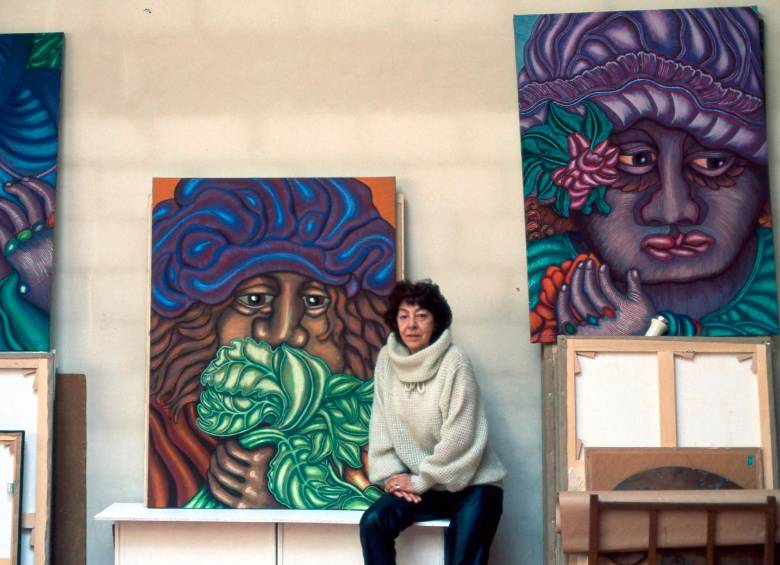
Emma Reyes is not a newly discovered artist. She is an artist whose visibility is finally catching up with the work. That distinction matters. White Cube Mason’s Yard opens the first solo presentation of Reyes in the United Kingdom on 4 September 2026, bringing paintings and works on paper from a career that lasted almost six decades into a London gallery context where many collectors will be encountering her for the first time.
The temptation with late-recognition stories is to make the market the protagonist: an overlooked artist appears, institutions take notice, prices follow, and a “rediscovery” is declared complete. Reyes deserves a slower account. Her work has been the subject of sustained estate, curatorial and institutional attention in recent years, including exhibitions at MAMCO in Geneva and CAPC in Bordeaux, while the Emma Reyes Foundation is developing the scholarship around her oeuvre. London is one more step in that process, not its beginning.
That makes the White Cube exhibition particularly useful for collectors. It offers a chance to look before the narrative hardens—to understand what changes across the work, what remains consistent, and why the paintings resist easy placement inside a single national, stylistic or market category.
Self-taught—but not isolated
White Cube describes Reyes as self-taught, an accurate shorthand for the absence of a conventional art-school formation. It should not be confused with artistic isolation. Her life involved travel, encounters with artists and periods of study and exchange; MAMCO’s account, for example, notes time spent working or studying in contexts associated with Diego Rivera and André Lhote.
The nuance matters because “self-taught” is a powerful market label. It can make an artist seem magically untouched by influence, as though originality emerged outside history. Reyes’s work is more interesting than that. She absorbed visual languages and then reorganised them according to her own intense sense of pattern, living form and pictorial pressure.
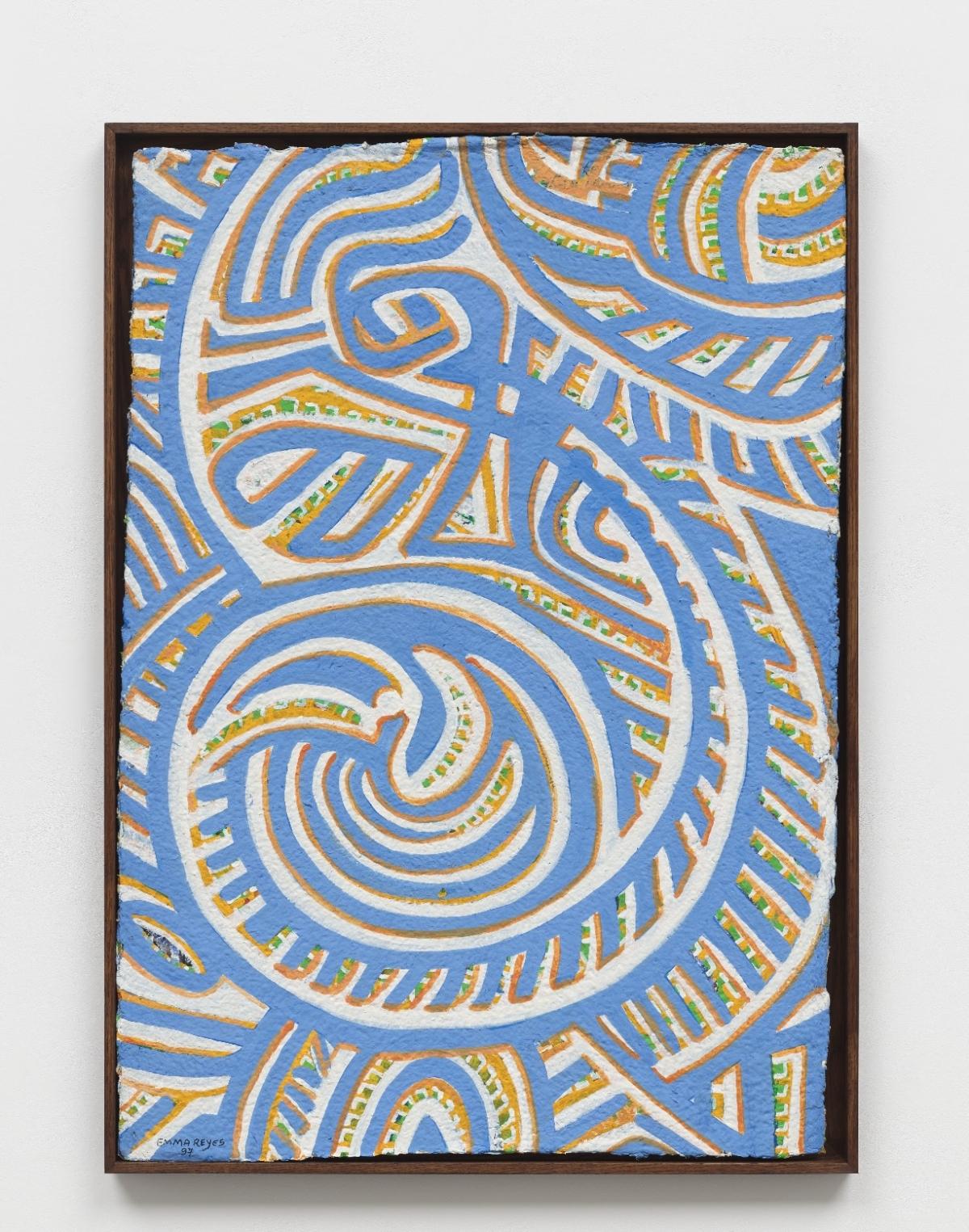
Across the decades, pre-Columbian artefacts, embroidery, basketry, botanical structures, portraiture and still life become less like separate sources than parts of one visual ecology. Lines repeat until they behave like fibres, veins, feathers, woven surfaces or fields of energy. A plant may resemble a body; a face may begin to behave like a landscape.
Why the surfaces matter
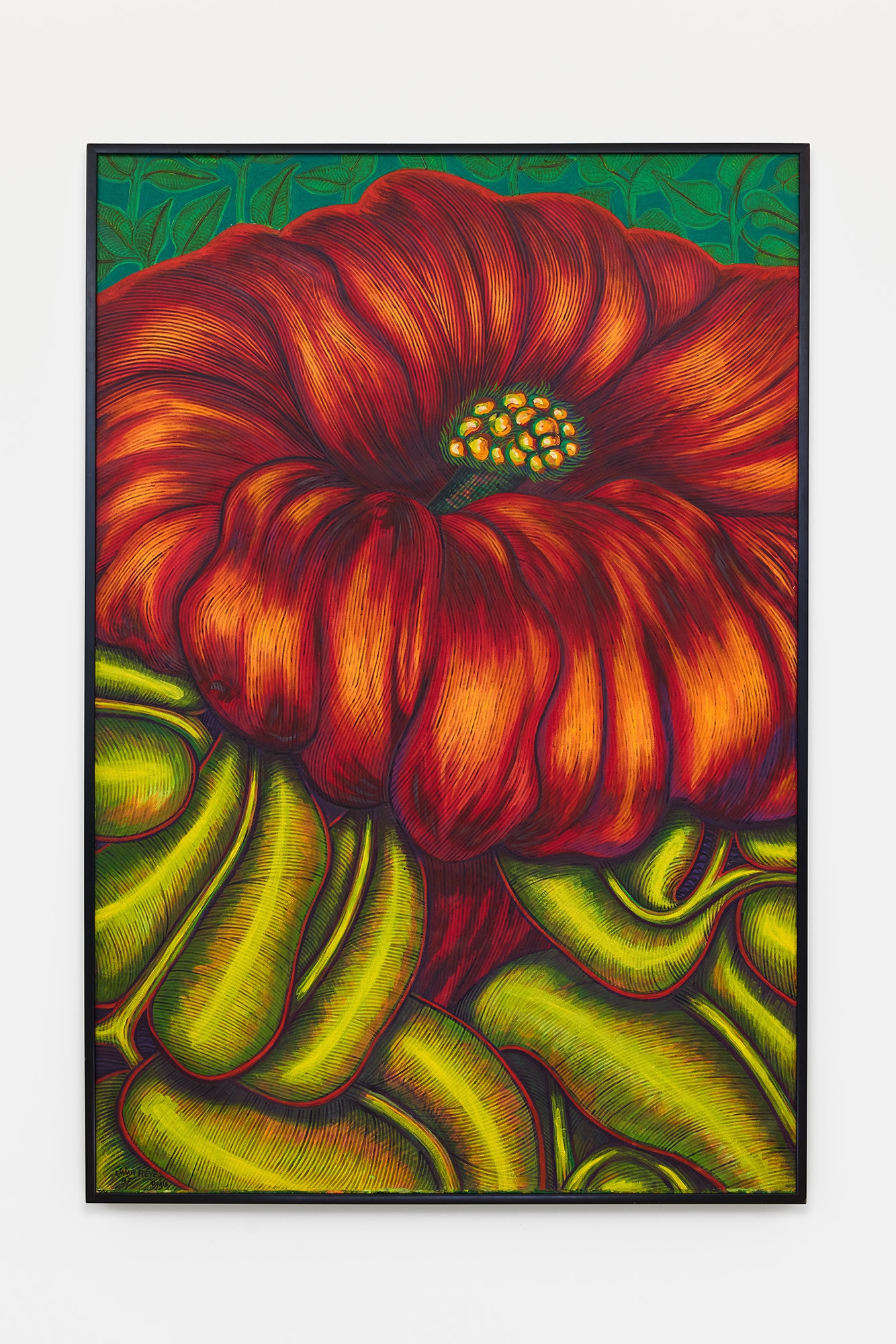
Reyes’s pictures often arrive first through colour. Reds, greens, oranges, blues and dense black contours can make the work instantly legible in reproduction, which is useful for visibility and dangerous for understanding. The real intelligence is in the surfaces.

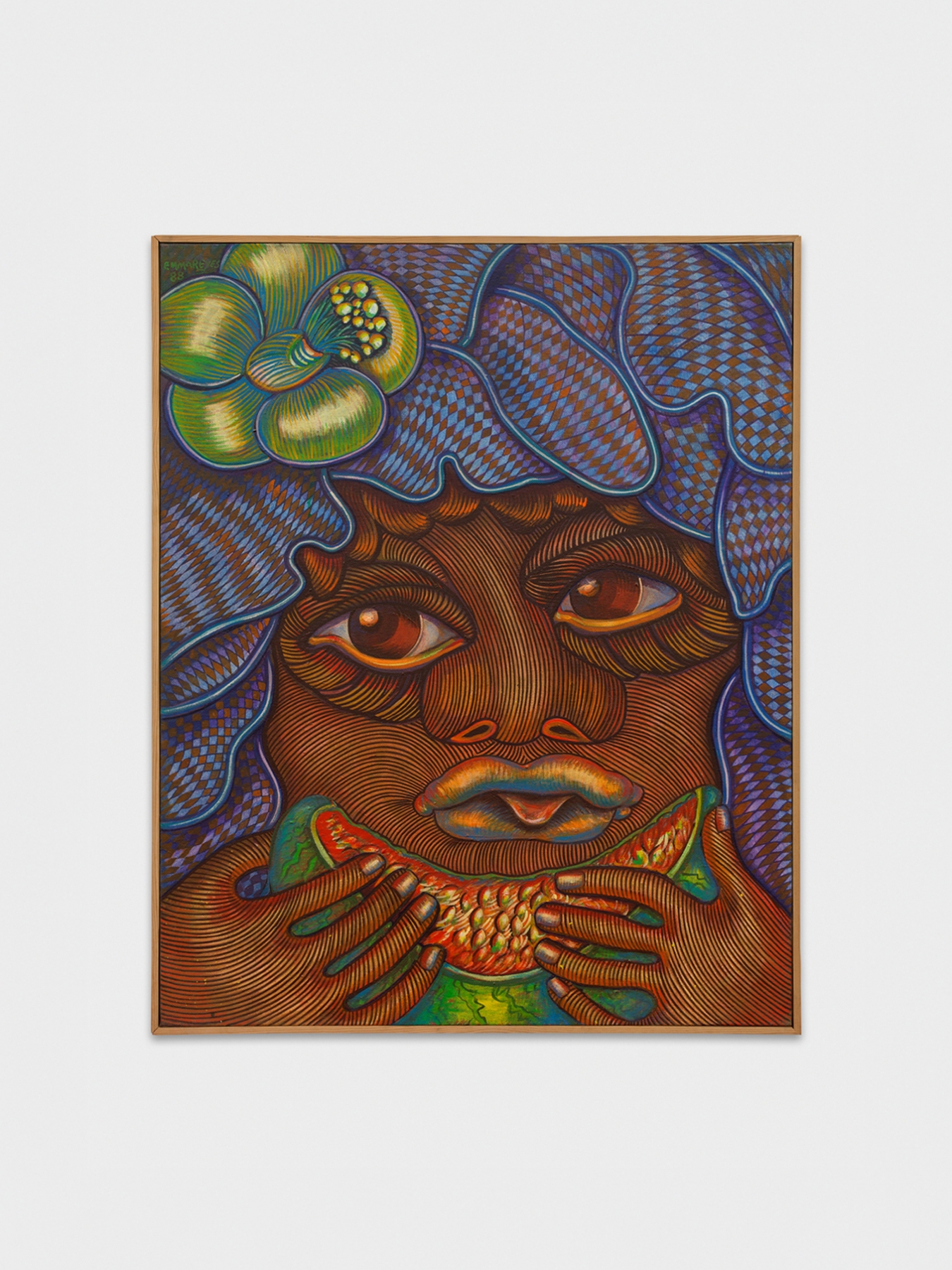
She builds form through repeated marks that can feel carved, woven or incised even when the support is paper or canvas. The effect is tactile without relying on literal texture. This striated language gives the work its continuity: a flower, face, garment or invented organic structure can all be constructed from related visual units.
That is one reason the paintings sit awkwardly within conventional categories of “Latin American modernism,” “outsider art,” “folk influence” or “surrealism.” Each label catches something and loses something. Reyes’s work does not simply quote indigenous or popular visual languages; it uses pattern to imagine a world in which human, vegetal and animal structures share formal ancestry.
The strongest rediscovery stories do not ask us to forgive art history for missing someone. They ask us to look closely enough to understand what the existing categories could not hold.
From still life to a living world
Reyes repeatedly reworked still life, but “still” is almost the wrong word. Her flowers push outward. Leaves fold into bodily shapes. Vessels and fruits can feel animate. Botanical motifs occupy the picture with the pressure of protagonists rather than decoration.
This is where her use of South American and pre-Columbian visual vocabularies needs care. The work should not be romanticised as direct access to some timeless indigenous essence. Reyes was a modern artist moving across cultures and geographies, actively transforming visual material within a twentieth-century practice. The point is not purity; it is translation.
White Cube frames the work in terms of reclaiming and transforming vocabularies from South American cultures that had long been absorbed into Western painting. That formulation is useful because it reverses the normal direction of influence. Rather than measuring Reyes by how closely she approaches European modernism, the work can be seen asking what European modernism already took, simplified or universalised from elsewhere.
The face becomes a mask, the mask becomes an environment
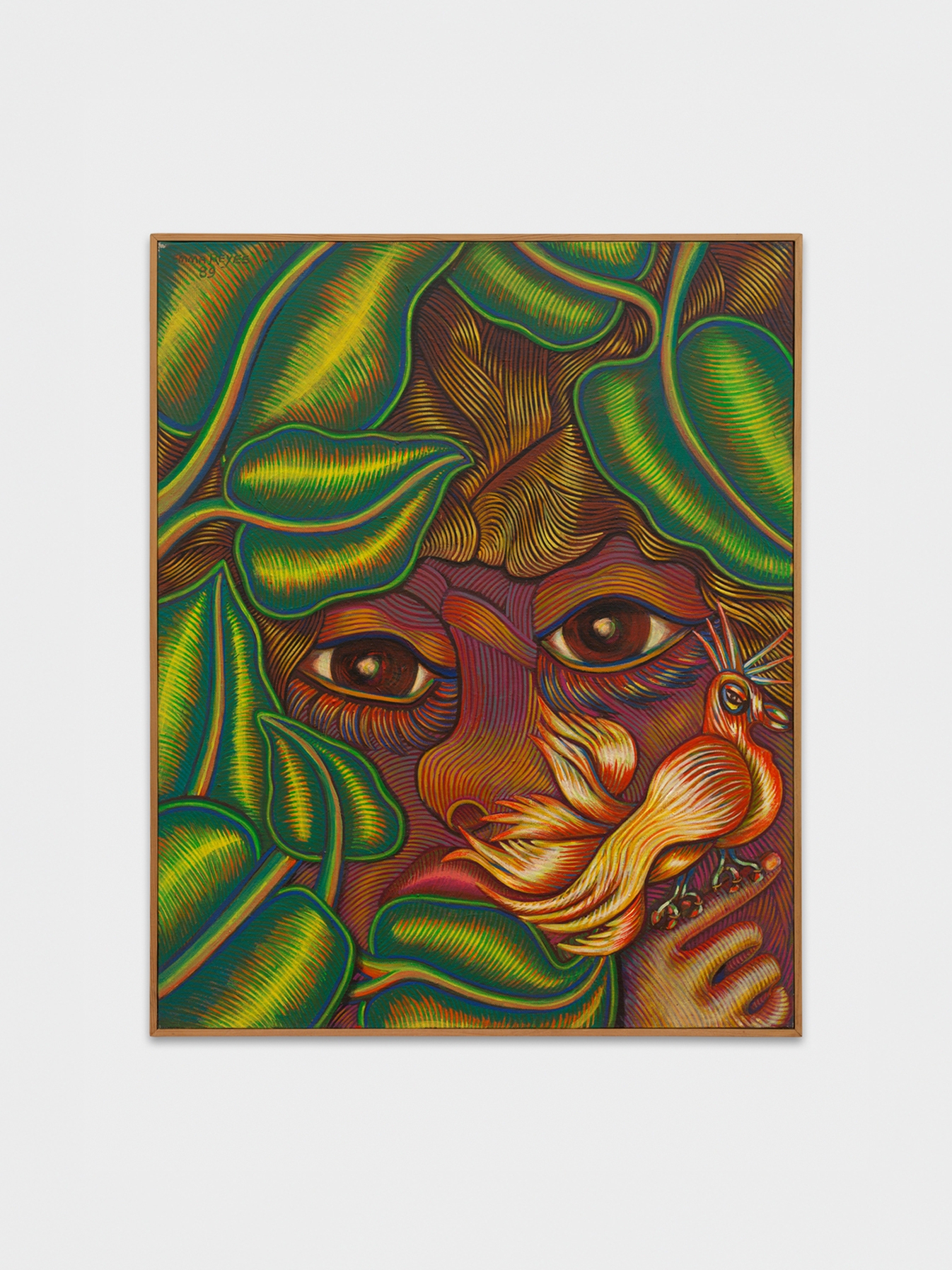
In the late work, especially the group often referred to as The Masks, begun around 1990 in Bordeaux, portraiture expands beyond individual likeness. Faces are composed from bands, organic motifs, headdresses, leaves, fruit and animal forms. The human subject is not erased; it is made porous.

Reyes drew on ritual masks from cultures across the Americas, Asia, Oceania and Africa. In weaker hands that breadth could become a catalogue of exotic references. Her strongest paintings instead use the mask as a formal problem: how can a face be simultaneously person, pattern, object and environment?
The repeated striations make the answer unstable. Eyes remain psychologically direct while everything around them refuses anatomical certainty. Hair can become foliage. Skin becomes a field of marks. A mouth may sit beside fruit or animal imagery without the composition resolving into simple allegory.

For collectors, this late period is likely to attract immediate attention because it is visually distinctive. That makes comparison particularly important. A recognisable “mask” is not automatically a major work. Scale, date, support, complexity, condition, provenance and the relationship between pattern and image should all be examined. The market tends to reward the motifs it can name fastest; connoisseurship begins where naming stops.
The role of the estate and foundation
Reyes’s current reassessment demonstrates how artist estates can change the visibility of a practice without inventing its historical importance. Stéphanie Cottin, president of the Emma Reyes Foundation, has been involved in recent curatorial work and is developing a catalogue raisonné. That kind of infrastructure is crucial for an artist whose career crossed countries, media and decades.
A catalogue raisonné is not merely a market authentication device. At its best it establishes chronology, titles, media, ownership histories, exhibitions and relationships between works. With an artist entering a period of accelerated attention, that information can prevent the market from getting ahead of scholarship.
The recent institutional sequence matters for the same reason. A retrospective at Maison des Arts d’Antony in 2022, MAMCO’s 2023–24 presentation and the 2025 Pollen project at CAPC have created contexts in which the paintings can be compared outside an auction-room narrative.

White Cube’s London exhibition adds a different form of visibility: access to an international collector network. Because the show appears within the gallery’s Inside the White Cube programme for non-represented artists, it also occupies an interesting position between scholarship and market formation. The question is not whether commercial attention is inappropriate. It is how carefully that attention can remain connected to the work’s emerging historical framework.
Biography should not swallow the painting
Reyes had an extraordinary life, and her autobiographical writing has contributed significantly to her public reputation. The risk is that a compelling biography can make the paintings feel like illustrations of survival, travel or identity. They are not.
The paintings establish their own chronology of formal decisions. Early works, the so-called “monsters,” botanical imagery, portraits, masks and works on paper reveal an artist repeatedly rethinking how living things can occupy a surface. Biography can explain circumstances and encounters; it cannot substitute for looking.
This matters especially in a rediscovery market, where stories are often packaged faster than scholarship. Collectors should ask the questions they would ask of any established artist: which periods are central? How secure is the dating? What exhibitions shaped the work? What is known about condition and materials? Which motifs were sustained rather than episodic?
Why works on paper deserve attention
The London exhibition includes works on paper alongside paintings, an important choice for a practice in which the line itself carries so much structural information. Paper can reveal the hand more directly. It can also expose how a motif develops without the authority conferred by scale or a conventional canvas support.
For collectors, paper may provide access at a different market level, but it should not be treated automatically as a lesser category. Support, mounting, colour stability, provenance and condition are critical. The repeated mark-making and intense pigments that make Reyes’s work visually compelling can also make conservation detail especially important.
Collector Notes
Exhibition: Emma Reyes at White Cube Mason’s Yard runs from 4 September to 3 October 2026 and is the first UK solo presentation of her work.
Terminology: “self-taught” is useful but incomplete. Reyes did not have a conventional academy education, yet her career involved sustained artistic encounters and periods of study. Avoid turning the label into a myth of isolation.
Scholarship: the Emma Reyes Foundation is developing the artist’s catalogue raisonné. As attention increases, documentation, provenance and inclusion in emerging scholarship should become more—not less—important.
Compare periods: do not assume the most recognisable late masks are automatically the only significant works. Botanical paintings, earlier figures, monsters and works on paper help establish the long development of her pictorial language.
Condition: ask for specialist reports, especially for acrylic and tempera on paper and works mounted to secondary supports. A visually intense surface can disguise subtle conservation issues in reproduction.
Market discipline: late recognition can produce fast repricing. Treat institutional attention as a reason to learn more, not a substitute for quality distinctions.
London is therefore not “discovering” Emma Reyes in 2026 so much as joining a reassessment already underway. That is a healthier way to understand the moment. It gives the paintings precedence over the market story and places the current exhibition inside a longer chain of curatorial, estate and scholarly work.
The best outcome of that chain would not be a rapid elevation of every Reyes work into a newly fashionable category. It would be a more precise history: one capable of explaining why these strange, patterned, living surfaces belonged to twentieth-century painting all along, even when the usual categories did not know where to put them.
On 200 acres at Snowmass, Jorge M. Pérez is approaching one hundred outdoor sculptures. The deeper story is how landscape, public access, philanthropy and weather change what a private collection can become.
White Cube presents the first UK solo exhibition of Emma Reyes, bringing six decades of intensely patterned painting into a market that is only beginning to catch up with her work. The real story is scholarship, not hype.